

What Is the Best Business to Start in 2026?
Choosing the best business to start is less about finding one universally superior idea and more about matching a business model to your skills, available capital, risk tolerance, customer access, and ability to deliver consistently. A profitable-looking idea can still be a poor choice if it depends on channels you do not control, requires more operating complexity than expected, or cannot be tested cheaply.
This framework is designed for an aspiring founder deciding what to launch in 2026. It follows a practical sequence: identify the problem, map the customer journey, locate the failure point, evaluate platform ownership, design the operating architecture, calculate cost and control, make a decision, and measure evidence.
Problem: What are you actually trying to solve?
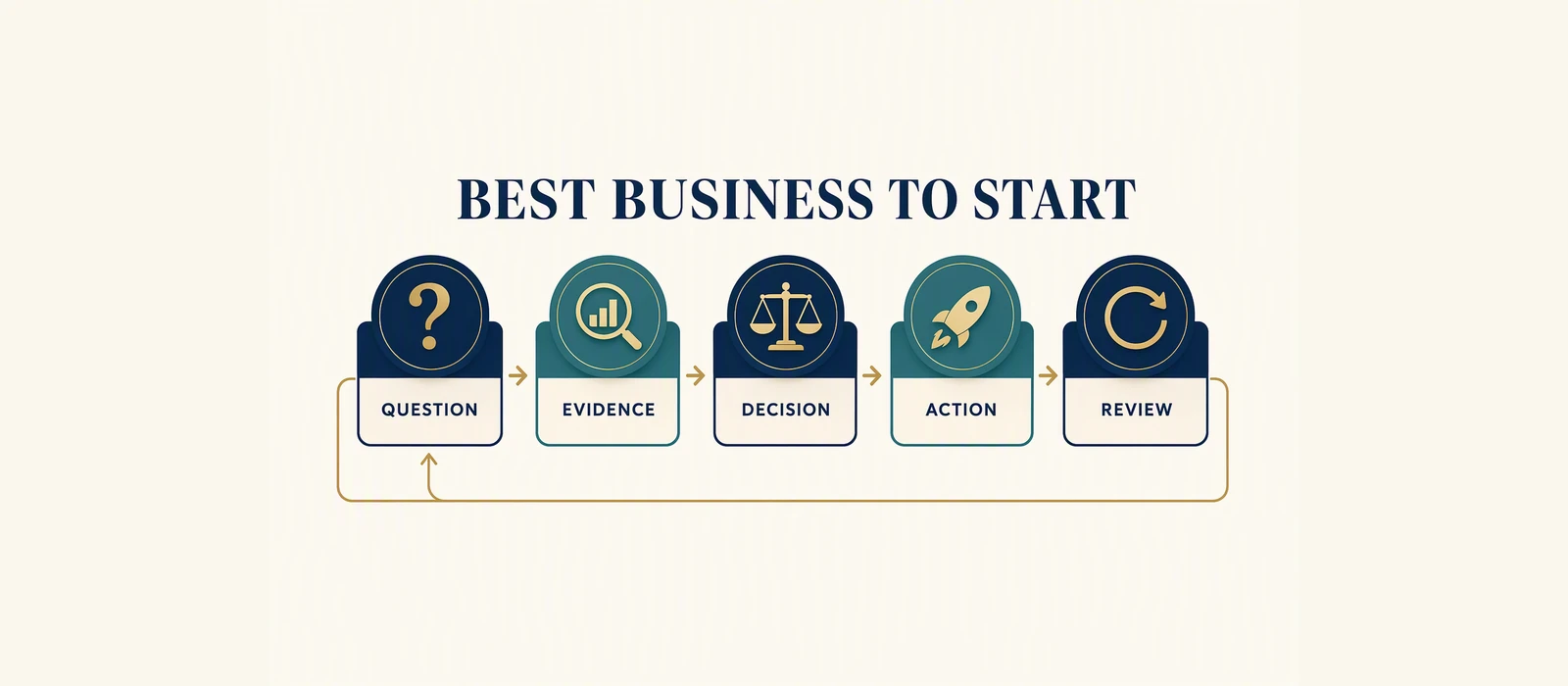
Many new founders begin with a product category: an online store, consulting service, newsletter, agency, app, or local service. A stronger starting point is the customer problem. The business exists to reduce a cost, delay, risk, frustration, or missed opportunity for a defined group of people.
Before comparing ideas, write a one-sentence problem statement:
For a specific customer, I will reduce this problem by delivering this measurable outcome through this repeatable method.
For example, “I want to sell marketing services” is broad. “I help independent home-service contractors turn unanswered inquiries into booked estimates using a managed follow-up process” is easier to test. It identifies a customer, a failure, and an outcome.
The user-provided US Startup Business Ideas Semrush database can help generate and compare demand-led directions. Treat it as an opportunity-discovery input, not proof that a business will succeed. Search interest can indicate that people are exploring a topic, but it does not establish willingness to pay, competitive difficulty, delivery feasibility, or legal suitability.
A problem-quality checklist
- Frequency: Does the problem happen often enough to justify a solution?
- Urgency: Is the customer already looking for an answer?
- Economic value: Can solving it save money, create revenue, reduce risk, or save meaningful time?
- Access: Can you reach potential customers without relying entirely on paid acquisition?
- Capability: Can you deliver a credible first version with your current skills or a realistic learning plan?
Journey: How does the customer move from need to result?
The best business ideas for small business operators usually have a journey that can be explained in a few steps. Map what happens before, during, and after the purchase:
- Trigger: What event causes the customer to seek help?
- Discovery: Where do they compare solutions—search, referrals, communities, marketplaces, social platforms, or local networks?
- Evaluation: What evidence do they need before trusting you?
- Purchase: Is the offer easy to understand and buy?
- Delivery: Can you provide the promised result repeatedly?
- Retention or referral: Is there a natural reason for a second purchase or recommendation?
A business with a short, repeatable journey often has an advantage over one that requires extensive education, custom proposals, or complicated fulfillment. This does not mean complex businesses are bad. It means their extra complexity should be justified by stronger customer value or pricing power.
If you are specifically considering home-based models, review the operational questions in this guide to starting a small business from home. A home business still needs a customer-acquisition plan, a professional delivery process, appropriate records, and any permits or insurance required for its location and industry.
Failure Point: Where do existing options break?
A promising business opportunity often appears at a failure point in the customer journey. Look for situations where the current solution is too slow, too expensive, too generic, difficult to use, or poorly matched to a specific customer segment.
Useful failure-point questions include:
- What do customers repeatedly complain about in reviews of competing products?
- Which task is being handled manually because existing software is too complicated?
- Where do prospects abandon the process?
- Which customer group is underserved by a broad, general-purpose offer?
- What work do businesses postpone because it is important but not urgent?
This is where “what is the best business to start” becomes a more useful question. The answer may be a service that removes a bottleneck, a specialized product that improves an existing workflow, or a simple information business that helps customers make a high-stakes decision.
Five opportunity patterns to compare
| Model | Typical strength | Common constraint | Good validation test |
|---|---|---|---|
| Productized service | Can start with expertise and limited inventory | Founder capacity may limit delivery | Sell a clearly scoped pilot to a narrow customer group |
| Local service | Direct access to a defined geographic market | Scheduling, travel, staffing, and local compliance | Secure paid bookings before buying substantial equipment |
| Digital product | Repeatable delivery after creation | Requires trust, distribution, and ongoing updates | Pre-sell a focused workshop, template, or program |
| E-commerce | Can create a tangible, differentiated offer | Inventory, returns, shipping, and margin pressure | Test demand with a small batch or documented pre-order process |
| Software or automation | Potentially repeatable and scalable | Development, support, security, and retention demands | Validate the workflow manually before building the full product |
The table is a decision aid, not a ranking. A model is only attractive when its constraints fit your resources and operating preferences.
Platform Ownership: Which parts of the business do you control?
Platform ownership is one of the most overlooked criteria when choosing a business. A founder may generate attention on a social network or marketplace without owning the audience relationship. An algorithm change, account restriction, fee increase, or policy update can then affect demand or margins.
Separate your business assets into three categories:
- Owned assets: customer records you lawfully maintain, your website, brand, product documentation, email list, operating procedures, and direct relationships.
- Rented channels: social accounts, advertising platforms, marketplaces, app stores, search rankings, and third-party communities.
- External dependencies: payment processors, hosting providers, suppliers, contractors, software vendors, and logistics partners.
Rented and external channels are not automatically bad. They can be efficient ways to discover customers and deliver value. The risk comes from treating them as permanent property. Build a path from rented attention to an owned relationship, subject to consent, privacy rules, and the platform’s terms.
For example, an email marketing system may help you communicate with opted-in contacts, but the vendor’s features, limits, pricing, and policies can change. Brevo’s official pricing page is the appropriate source for current plan details and terms. The vendor page is evidence of what Brevo currently states about its own offer; it is not independent proof of deliverability, revenue, or business performance.
Architecture: What must exist for the business to operate?
Before choosing an idea, sketch its minimum operating architecture. This prevents a common mistake: selecting a business based on its front-end promise while ignoring the back-end work required to fulfill it.
The minimum viable business system
- Offer: A defined product or service, customer, scope, price logic, and promise.
- Demand channel: A realistic way to reach prospects, such as referrals, search content, partnerships, outbound contact, local networking, or paid media.
- Conversion path: A landing page, consultation, checkout, booking flow, or proposal process.
- Delivery system: The people, tools, files, inventory, scheduling, and quality checks needed to fulfill the offer.
- Customer communication: A consent-based method for confirmations, updates, support, and follow-up.
- Recordkeeping: A process for expenses, revenue, customer information, contracts, tax documentation, and operational decisions.
- Feedback loop: A way to collect customer objections, delivery issues, outcomes, and repeat-purchase signals.
Keep the first architecture deliberately small. If you need a complex stack before you have a confirmed customer problem, the stack may be substituting for validation. The startup stack under $100 guide can help you think through a lean initial setup. Verify current prices, usage limits, taxes, integrations, and terms directly with each provider before purchasing.
For email and lifecycle communication, compare the job to be done rather than selecting a tool because it is popular. Brevo’s official pricing information should be checked for current plan inclusions, billing conditions, and applicable limits. Do not assume a public discount, free trial, or other promotion is available unless the current official terms explicitly confirm it.
Cost and Control: What does the first version really require?
A good business to start with little money is not simply the idea with the lowest software bill. It is a model where the founder can test demand and deliver an initial result without committing too much cash, time, inventory, or irreversible complexity.
Calculate four types of startup cost
| Cost category | Questions to ask |
|---|---|
| Cash | What must be paid before the first sale? Include equipment, permits, insurance, software, samples, inventory, and professional services. |
| Time | How many hours are required to acquire, sell to, serve, and support the first customers? |
| Opportunity cost | What income, education, family time, or other project will be displaced? |
| Risk | What could create refunds, liability, compliance exposure, data loss, dependency, or reputational damage? |
Then score each candidate from 1 to 5 on the following dimensions:
- Customer access
- Speed to first credible test
- Gross-margin potential
- Repeat-purchase or referral potential
- Founder capability fit
- Operational simplicity
- Ownership of customer relationships
- Regulatory and liability manageability
Use weights if one factor matters more to you. For instance, a parent starting part-time may assign greater weight to schedule flexibility, while an experienced operator may prioritize repeatability and hiring potential. This makes the decision personal and explicit instead of pretending that one idea is best for everyone.
Decision: Which business should you choose?
Choose the idea that earns the strongest evidence-adjusted score—not the idea with the most exciting branding or the largest theoretical market. A practical decision rule is:
Start with the narrowest offer that solves a meaningful problem, can reach a specific customer group, can be delivered with your current resources, and can produce evidence within a defined test period.
For many founders, that points first toward a productized service, specialized local service, or narrowly defined digital offer. These models can provide direct customer feedback before significant investment. That is not a promise that they will outperform products, e-commerce, or software. It is a validation advantage when the founder has relevant skills and customer access.
If your shortlist includes several tools or business models, use the GSA small-business tools hub as the next decision point. It can organize the tool-selection stage, but current vendor terms remain the authoritative source for pricing, plan limits, features, and eligibility.
When evaluating Brevo specifically, consult the official Brevo pricing page at the time of purchase. No public discount, free-trial availability, scarcity statement, or expiry date is verified here. Check the current official terms instead, including billing frequency, included limits, overage rules, taxes, cancellation conditions, and any regional differences.
A 14-day validation sequence
- Interview or observe at least a small set of people who experience the problem. Ask about current behavior, not only hypothetical interest.
- Write one narrow offer with a clear scope and customer outcome.
- Create a simple explanation and a way for an interested person to respond or book a conversation.
- Ask for a paid pilot, deposit, booking, or another meaningful commitment where appropriate.
- Deliver manually and document every repeated step, objection, delay, and support request.
- Review the evidence before investing in automation, inventory, branding, or a larger advertising budget.
Measurement: What evidence tells you to continue?
Measurement should distinguish attention from commercial validation. Page views, social engagement, and keyword interest can be useful leading indicators, but they are not the same as qualified demand or profitable delivery.
Track the decision funnel
| Stage | Example measure | What it can tell you |
|---|---|---|
| Reach | Relevant visitors, referrals, or conversations | Whether your message is reaching the intended audience |
| Interest | Qualified replies, calls, sign-ups, or quote requests | Whether the problem and positioning prompt action |
| Conversion | Paid pilots, bookings, deposits, or completed checkouts | Whether interest becomes commercial commitment |
| Delivery | Hours, direct costs, rework, refunds, and completion time | Whether the offer can be delivered at a sustainable margin |
| Retention | Repeat purchases, renewals, referrals, or expansion | Whether the value persists beyond the first transaction |
Set a review date and a pre-decided threshold for changing the offer. For example, you might continue if conversations reveal a consistent problem and at least some prospects accept a paid pilot; revise if people show interest but reject the scope or price; and stop if you cannot reach the target customer or deliver safely and profitably.
Do not treat vendor marketing claims as business results. A software provider may describe features, plans, or intended benefits on its official page. Those statements can establish what the vendor says it offers, but they do not guarantee your open rates, sales, savings, compliance outcome, or return on investment. Test the workflow with your own customers and records.
FAQ
What is the best business to start for a beginner?
The best starting point is usually a narrow, low-complexity offer that matches the founder’s capabilities and gives direct access to customers. A productized service, local service, or focused digital offer may be easier to validate than a capital-intensive model, but the right choice depends on the founder’s market and constraints.
What is a good business to start with little money?
Look for a model that can be tested before buying inventory or building custom technology. Services, consulting, pre-sold workshops, specialized digital products, and manual versions of future software can sometimes reduce initial cash requirements. “Low cost” does not mean no cost: account for time, permits, insurance, customer acquisition, taxes, and delivery expenses.
What are practical home business suggestions?
Potential categories include remote professional services, tutoring, design, bookkeeping, content production, specialized consulting, online education, and small digital products. Validate demand and confirm local rules, zoning, tax, insurance, privacy, and licensing requirements before operating from home.
How do I find the best entrepreneur ideas?
Combine demand research, customer conversations, competitor review analysis, your own capabilities, and a paid validation test. The user-provided Semrush startup-ideas database can support discovery, while customer commitments and delivery economics provide stronger decision evidence.
Should I choose a scalable business or a simple business?
Choose the simplest model that can prove the problem and economics. Scalability matters only after customers value the offer and the delivery process is understood. A simple service can reveal the workflow that a future product, subscription, or software business might automate.
Are Brevo prices, discounts, or free trials guaranteed in this article?
No. Current pricing and plan terms can change, and no public discount, free trial, scarcity claim, or expiry date is verified here. Check the official Brevo pricing page for current information before making a purchase.
Bottom line: The best business to start in 2026 is the one you can test with a real customer, deliver responsibly, and improve using evidence. Start with the problem, protect the customer relationship, keep the architecture lean, calculate the full cost of control, and let paid validation—not hype—determine the next investment.
- Brevo pricing official; verified 2026-09-30
Affiliate disclosure: This article may contain sponsored affiliate links. If you purchase through one, GSA may earn a commission at no additional cost to you. Recommendations are based on fit, operational trade-offs, and publicly available evidence, not commission rates.
See which pages lose clicks
Run the free website SEO audit to find the pages Google already shows but that earn almost no clicks, then fix the highest-impact issues first.