
Home › SEO Audit › On-Page SEO Audit
On-page SEO is the work you fully control: the content, structure and metadata of each page. An on-page SEO audit finds the pages where those signals are weak – and fixes them.
US search visibility and measured page experience
In the latest complete latest visibility window, 445 US impressions and 0 US clicks were recorded for this URL, with an aggregate US average position of 36.0. This is a dated visibility signal, not a PageSpeed score for this specific URL and not proof of a lead, sale, or revenue outcome.
Open the live PageSpeed mobile test → · Run our Website SEO Audit →
Open the live PageSpeed mobile test → · Read our dated case study →
Why it matters here: US search visibility makes page selection and page experience worth measuring together. The homepage benchmarks are evidence for the broader technical-performance report; they are not a substitute for testing this URL under the same conditions.
Read the dated PageSpeed report and screenshots → · See the audit methodology →
Why On-Page SEO Matters to Business Results
Search visibility is not the same as business value. The useful path is impression → click → relevant page experience → enquiry or purchase. On-page SEO can improve the parts of that path the site owner controls, but it cannot guarantee rankings, traffic, sales, or revenue.
Then and now: GSA Search Console evidence
Important context: GSA’s domain, information architecture, and page inventory changed materially after March 2026. This comparison is directional context, not a controlled experiment and not proof that on-page SEO alone caused the movement.
Historical baseline snapshot: The published GSA baseline recorded 15,668 impressions, 42 clicks, 0.27% CTR, and average position 16.2.
Previous complete window: 2026-04-10 to 2026-07-08: 45,274 impressions, 42 clicks, 0.09% CTR, average position 11.7.
Latest complete window: 2026-07-09 to 2026-10-06: 22,559 impressions, 65 clicks, 0.29% CTR, average position 21.1.
| Metric | Previous complete window | Latest complete window | Change |
|---|---|---|---|
| Impressions | 45,274 | 22,559 | -22715 (-50.2%) |
| Clicks | 42 | 65 | +23 (+54.8%) |
| CTR | 0.09% | 0.29% | +0.20 percentage points |
| Average position | 11.7 | 21.1 | +9.3; lower is better |
These measurements show search visibility and selected visits. They do not by themselves establish rankings, leads, sales, or revenue.
What is on-page SEO?
On-page SEO (sometimes called on-site SEO) is the practice of optimising individual pages so they rank and convert: title tags, meta descriptions, headings, body content, keyword usage, internal links, images, schema and calls to action.
Latest PageSpeed reports: 2026-10-09
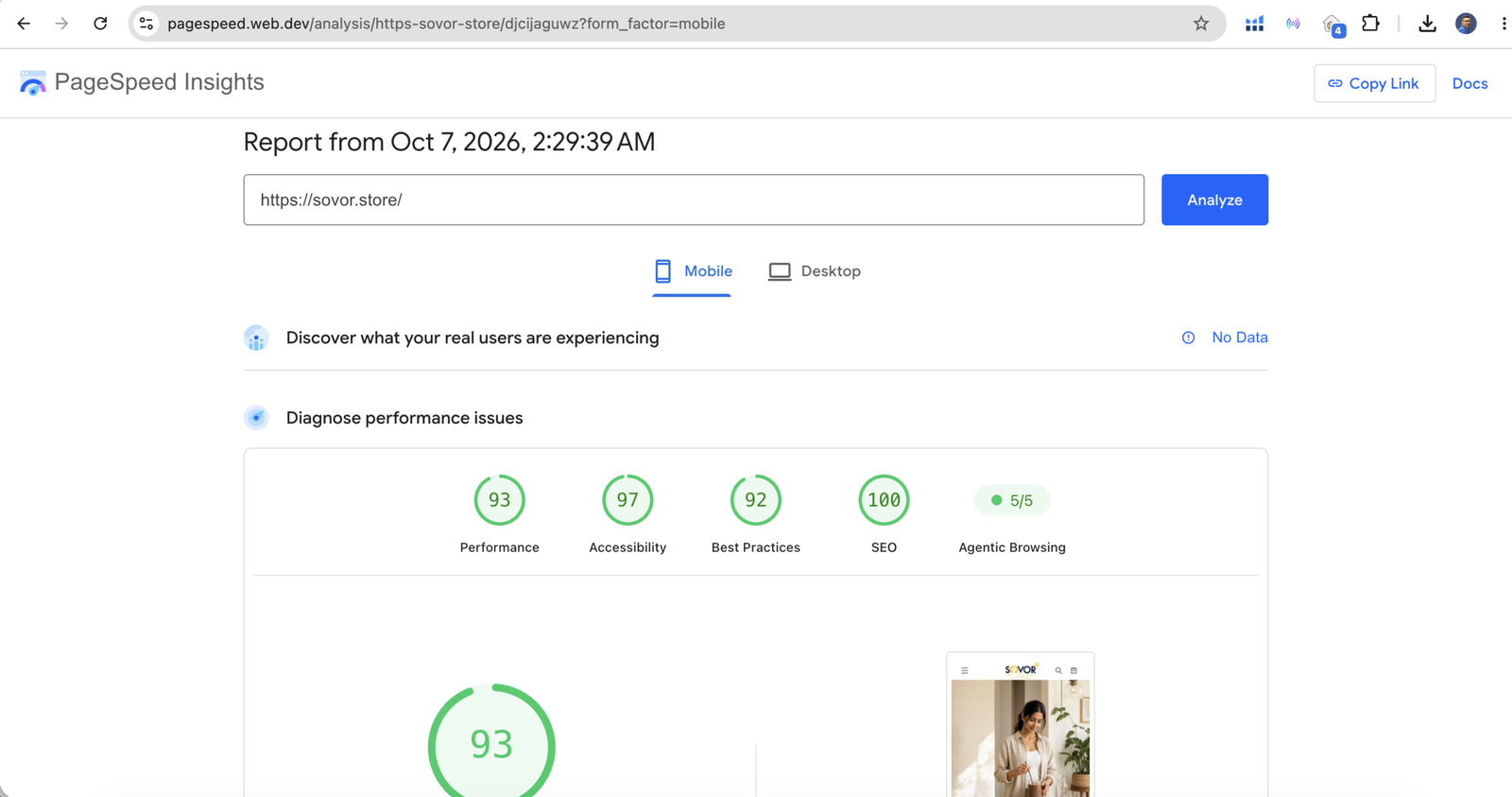
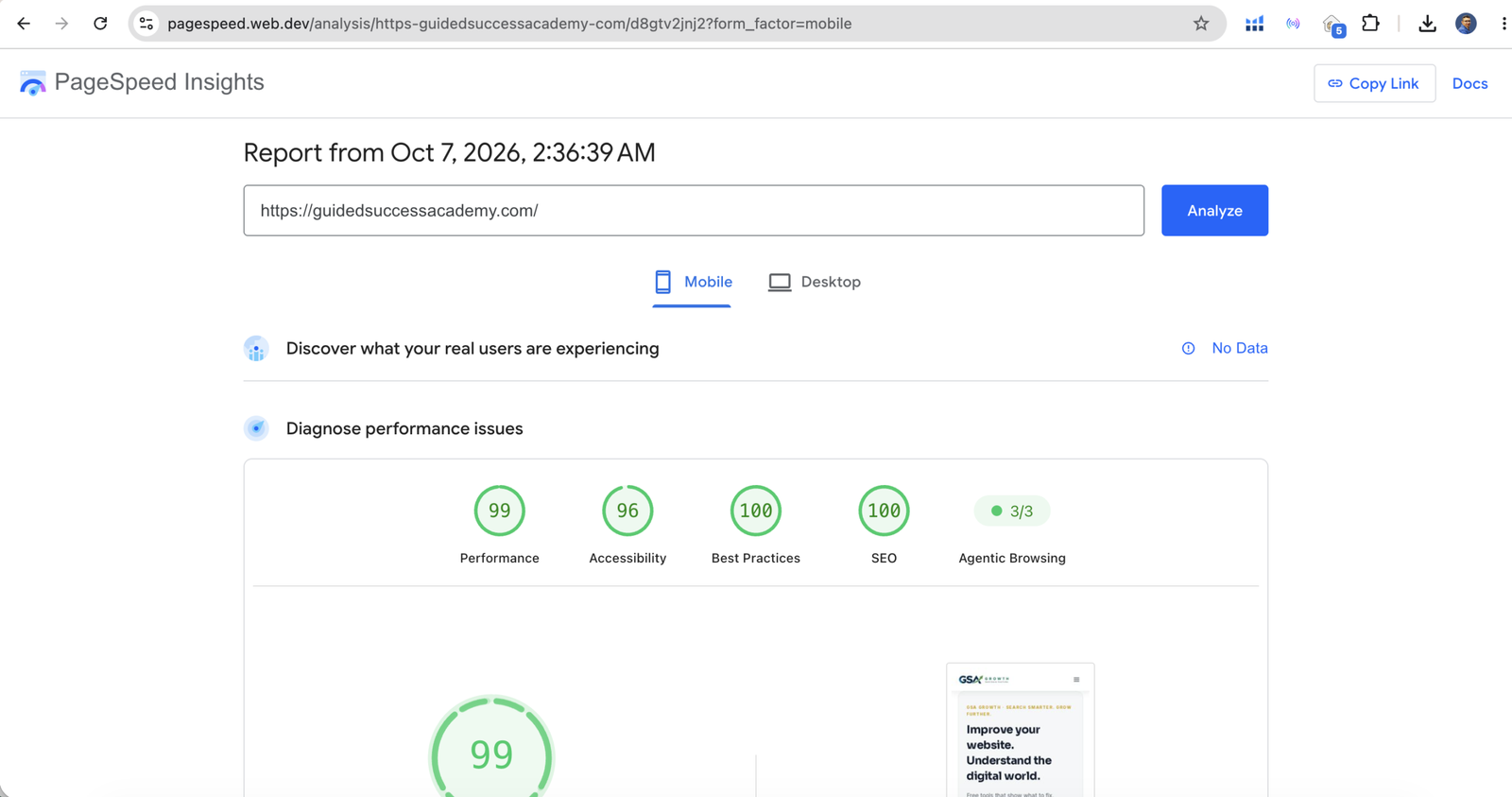
These are dated Lighthouse lab measurements for two separate properties. The screenshots below are the supplied October 7 mobile reports; the table is refreshed daily using the median of three multi-category page-experience checks runs per property and device. The screenshot and API observations remain labelled separately. Field or CrUX data was unavailable.
| Property | Device | Performance | Accessibility | Best Practices | SEO | FCP | LCP | CLS |
|---|---|---|---|---|---|---|---|---|
| SOVOR | 3-run mobile median | 72 | 97 | 92 | 100 | 1.9s | 3.2s | 0.439 |
| SOVOR | 3-run desktop median | 83 | 97 | 92 | 100 | 0.5s | 0.7s | 0.344 |
| GSA | 3-run mobile median | 99 | 92 | 100 | 100 | 1.2s | 1.9s | 0.043 |
| GSA | 3-run desktop median | 99 | 93 | 100 | 100 | 0.4s | 0.6s | 0.005 |
On-page vs technical vs off-page SEO
| Discipline | Focus | Examples |
|---|---|---|
| On-page | The page itself | Titles, headings, content, internal links, schema |
| Technical | Infrastructure | Crawl, index, speed, Core Web Vitals, canonicals |
| Off-page | Authority | Backlinks, digital PR, brand mentions |
On-page SEO audit checklist
Six groups. Work top to bottom.
Titles & descriptions
- Unique title tag per page, 50-60 characters, primary keyword front-loaded.
- Meta description 120-160 characters with a reason to click.
- Open Graph and Twitter tags set for social sharing.
Headings & URL
- Exactly one H1 that matches the page’s main intent.
- Logical H2/H3 hierarchy that reads as an outline.
- Descriptive, hyphenated URL.
Depth & intent
- Matches the dominant search intent of the target query.
- Deep enough to answer fully (usually 600+ words).
- Claims sourced and dated; no invented statistics.
- A single, relevant next action (CTA).
Context & equity
- 3-6 contextual internal links with descriptive anchors.
- Money pages receive links from supporting content.
- No broken internal links.
Alt text & formats
- Descriptive alt text on every meaningful image.
- Modern formats (WebP/AVIF) with explicit dimensions.
Structured data
- Article/BlogPosting on posts, FAQPage where FAQs exist.
- BreadcrumbList on inner pages; Organization on the homepage.
On-page SEO tools
On-page SEO services
Frequently asked questions
How often should I audit on-page SEO?
What is the most important on-page factor?
Is on-page SEO enough on its own?
Related guides
Sources
Run a free SEO audit
Get a prioritised diagnosis in under a minute – no signup. Or book a 30-minute strategy call ($99) and we’ll tell you what to fix first.
Choose your package
Secure checkout via PayU. Prefer to chat? Message us on WhatsApp.
Dehradun local SEO resources
Move from the broad question to the most useful next decision: