
Home › Case studies › Case study library
GSA Sitewide SEO Audit: 179 URLs, Four Findings
A full crawl of 179 published URLs on guidedsuccessacademy.com returned zero broken internal links, zero duplicate titles, and zero duplicate canonicals — and exactly four error or warning items out of 97 findings. The interesting number is not the four. It is the 66 orphan candidates, 50 of which sit in a single location silo linked by design one-to-one rather than through a public city list. Search data shows those pages are seen but not chosen: 42 of them collected 2,963 impressions and one click in 90 days.
Business Context
Guided Success Academy is a WordPress site that has grown past the point where anyone can hold its structure in their head. It carries service pages, audit tools, a large local SEO section, and a broad body of consumer and comparison articles. When a site reaches that size, the risk stops being ‘is this page well optimised’ and becomes ‘does the published surface still hang together as one coherent thing’. A sitewide audit answers that second question. It is a check on coherence, not a score on individual pages.
The Challenge
The site needed a repeatable way to confirm that everything it publishes is technically reachable, correctly described, and not colliding with itself. That meant checking the things that break silently as a site grows: two pages claiming the same title, two pages claiming the same canonical, a link pointing at a URL that no longer exists, and pages that no other page links to at all. The audit also had to be honest about the difference between a defect and a judgement call. An orphan page is a fact. Whether that orphan is a mistake depends on editorial intent, and the audit was built to report the fact without pretending to know the intent.
What Was in Scope
- All 179 published URLs across 127 Pages and 52 Posts
- Rendered titles, meta descriptions, headings, canonicals, and robots directives
- Structured data types present, images, and internal and external links
- Sitemap coverage, robots.txt, broken-link, and orphan-candidate checks
- Page-level word counts and heading structure
- The latest complete Search Console window available at audit time
Before and After at a Glance
A plain-language view of what was measured, what it looked like before, and what it looks like now. Each change is labelled so a score is never read on its own.
| The issue | Before | After |
|---|---|---|
| The size of the surface being checked127 Pages and 52 Posts were crawled. | Not measured | ▲ Improved179GSA sitewide audit, 2026-10-08 |
| Defects that need a decisionTwo H1 issues and two over-long titles. | Initial baseline not retained | ▼ Lower4GSA sitewide audit, 2026-10-08 |
| Links pointing at URLs that no longer resolveEvery internal link followed resolved successfully. | Not measured | ■ Unchanged0GSA sitewide audit, 2026-10-08 |
| Published URLs with no inbound internal link57 of the 66 sit in one location silo; 42 of those pages were still seen in search. | Not measured | ▼ Lower66GSA sitewide audit, 2026-10-08 |
These are dated lab measurements, not a universal visitor experience. Read each row with its source and the limitations at the end of this report.
Evidence and Baseline
The audit is a dated, read-only crawl of the live site conducted on 2026-10-08. It recorded 179 published items, 127 Pages and 52 Posts. Every figure in this report — the four error or warning items, the 66 orphan candidates, the zero counts for broken links and duplicates — comes from that single recorded run. The crawl is read-only: it inspects the rendered site and does not write to it. Search Console figures in this report come from the window 2026-07-08 to 2026-10-05, which is the window the audit recorded alongside its technical findings, and they are kept separate from the technical results because they measure different things.
Timeline
- Definition The audit was scoped to coherence rather than page-level scoring: duplicates, broken links, canonicals, and reachability.
- Crawl All 179 published URLs were crawled read-only on 2026-10-08, recording rendered metadata, structure, links, and sitemap coverage.
- Review Findings were separated into four error or warning items and 93 informational observations, and the orphan set was broken down by section.
What 179 URLs actually returned
The crawl checked 179 published URLs: 127 Pages and 52 Posts. Against that surface it found three defects of the kind that usually accumulate quietly on a site this size.
Broken internal links: zero. Duplicate titles: zero. Duplicate canonicals: zero. Those are the checks that matter most for a growing site, because a broken internal link wastes crawl attention and a duplicate canonical splits a page’s signals between two URLs. On this run, neither happened.
That is a genuinely clean result, and it is worth saying why it is believable rather than just convenient. These three checks are mechanical. The crawler does not form an opinion about a broken link; it follows the link and records the response code. Zero here means zero, not ‘none we noticed’.
The four findings, named
The audit returned exactly four items at error or warning level, out of 97 total findings across the site. The other 93 are informational. Four is a small number, but each one is specific and each one is fixable, so it is worth naming them rather than summarising them as ‘a few issues’.
First, the Revenue-Leak Audit page at /seo-revenue-leak-audit/ renders two distinct H1 headings. The audit flags this as an error because a page with two H1s gives a crawler no single unambiguous statement of what the page is about. The page’s title tag is also 69 characters, which is the second finding: the audit’s target range is 30 to 65, because longer titles are frequently truncated in search results.
Third, the post /best-cpanel-hosting-2026/ carries a 69-character title, the same length problem on a different URL. Fourth, /best-web-host-small-business/ renders the same H1 twice — a duplicate rather than a conflict, but still two headings where the page structure expects one.
Two of the four sit on the same page, which is a useful detail. It suggests the Revenue-Leak Audit page was built from a template that expects one H1 and then had a second added, rather than two separate problems occurring independently.
Technology that passed, and what that does not mean
Beyond the four findings, the audit recorded 93 informational items. These are worth understanding because they are not failures — they are observations that fall below the threshold the audit treats as a defect.
51 pages carry at least one non-brand image without an explicit loading attribute. This does not break anything, but it means the browser decides on its own when to load those images. 24 pages have a heading that skips a level in context, which can affect how a screen reader announces the page but does not affect indexation. Seven pages have a canonical URL that differs from the URL the crawler expected, and seven are marked noindex — both of which are correct for the pages involved, but are recorded so the state is visible.
The point of listing these is to draw the line honestly. A site with 93 informational notes and four real findings is not a site with 97 problems. It is a site with four problems and 93 things someone might reasonably decide to improve.
The 66 orphan candidates, and the silo behind them
The audit found 66 URLs that no other page on the site links to. These are orphan candidates: pages that exist, are published, and are technically reachable by direct URL, but that a visitor browsing the site or a crawler following internal links would never arrive at.
The important detail is not the total. It is the distribution. Of the 66, fifty sit in the /local-seo/ section — the city and niche landing pages built for the local SEO service. Six more are /local-seo-for-* pages from the same family, and one is a /dehradun/ page. That is 57 of 66 in a single content silo.
That number is a statement about how the location pages were built, not a verdict on whether they should exist. In this case the distribution has a documented cause: the location pages are deliberately linked one-to-one from relevant guides rather than collected into a public city or market directory, because publishing such a directory would expose the market research behind it. The orphan concentration is therefore a consequence of an editorial and disclosure decision, not evidence of an unmanaged silo.
The audit cannot tell whether an individual orphan is a mistake, because that depends on intent. An orphan page is a fact; whether it is a fault is a judgement the site owner makes. An audit that guessed at the judgement would be less useful than one that reports the fact and stops.
What the number does establish is that the question is concentrated in one place rather than scattered, which makes it answerable in one review rather than fifty. It does not establish that a mass internal-linking pass is the right response. Adding inbound links across a large, deliberately-distributed section can spread link equity thinner rather than strengthen it, so the decision is an editorial one about which pages deserve to be promoted — not a mechanical exercise in reducing a count.
The remaining nine orphans outside that silo are individually listed in the audit: /seo-revenue-leak-audit/, /review-velocity-calculator/, /local-seo-tool/, /dentist-seo/, /gsa-ads-tooling/, and four ‘alternatives’ comparison pages for Woorank, Ubersuggest, Moz, and Screaming Frog. Several of these are the kind of page that is deliberately reached from search rather than from browsing, which is exactly why the audit stops at reporting.
The orphans are not invisible — they are unselected
An orphan candidate is a page with no internal link. That is not the same as a page search engines cannot find, and the search data makes the difference plain.
Across the 90-day window from 2026-07-09 to 2026-10-06, 42 of the city pages returned Search Console rows. They were seen. What they did not do was earn clicks: those 42 pages accounted for 2,963 impressions and a single click between them.
The two figures have to be read together. A page with no internal link that still collects hundreds of impressions is not hidden from search — it is being surfaced and then passed over. That reframes the finding. The problem in this section is not discoverability, which internal linking would fix. It is selection, which internal linking does not.
Two examples make the pattern concrete. Phoenix is the largest and most awkward: 350 impressions at an average position of 54.7, meaning it is being shown several pages deep for a query it cannot compete on. San Jose is the opposite and more useful: 123 impressions at an average position of 13.9, within reach of page one. Indianapolis sits at 15.4. Those two are the only city pages in the set close enough to page one for small improvements to matter.
This is why the report does not recommend a blanket linking pass. Adding inbound links across 50 pages that are collectively earning one click per quarter would spread attention rather than concentrate it. The evidence points the other way: identify the two or three pages already nearest the first page, decide whether they deserve the support, and let the remainder be judged on the same data before anything is built around them.
That judgement is explicitly not made here. What the window supports is the measurement — 42 pages seen, 2,963 impressions, one click — not a verdict on any individual page.
Sitemap coverage
The audit confirmed robots.txt returns a 200 response and identified the sitemap index at /sitemap_index.xml, which contained 172 URLs at the time of the crawl against 179 published items.
The seven published URLs absent from the sitemap are not random. They include /thank-you, /style-guide, /terms-and-conditions, /newsletter-for-entrepreneurs/ and similar utility surfaces. Utility pages are commonly excluded from sitemaps on purpose, because they are functional rather than editorial and there is no value in asking a search engine to index them. The audit records the discrepancy; it does not treat it as a fault. As with the orphans, the correct response depends on whether the omission was intentional, and on this evidence the pattern suggests it was.
What a clean technical result does not prove
A sitewide audit measures structure. It confirms that the published surface is coherent, that URLs resolve, and that no page is silently colliding with another. It does not measure whether the content is any good, whether anyone wants it, or whether it earns anything.
Specifically, this audit does not prove rankings, traffic, leads, or revenue. Zero broken links does not mean a site ranks, and four findings does not mean a site is failing. The two are independent, and a report that implied otherwise would be using a technical result to make a commercial claim it cannot support.
It also does not infer backlink quality. The number and strength of external links pointing at a site is not visible from a crawl of the site itself, and no backlink claim appears anywhere in this report for that reason.
Finally, an orphan candidate is not a defect. It is a URL that lacks an internal link. The judgement about whether that matters belongs to the person who knows what the page is for.
What Improved
- The site’s published surface is confirmed coherent: no broken internal links, no duplicate titles, no duplicate canonicals across 179 URLs.
- The four real findings are named individually, so each can be fixed as a specific task rather than a vague review.
- The orphan concentration in the /local-seo/ section is now visible, dated, and paired with search evidence showing those pages are seen but not chosen.
- Informational findings are separated from defects, so 93 observations are not mistaken for 93 problems.
- The audit is repeatable, so the next run produces a comparable baseline rather than a fresh opinion.
What Remains Unresolved
- Orphan candidates are not automatically defects. The /local-seo/ concentration follows from one-to-one linking by design, and the pages are seen in search — 42 returned rows — but produced one click in 90 days.
- The audit does not infer backlink quality and makes no claim about external links.
- A zero-error technical result does not guarantee rankings, traffic, leads, or revenue.
- Seven published URLs sit outside the sitemap; the pattern suggests deliberate exclusion of utility pages, but intent was not confirmed page by page.
- This is a single dated crawl. Site conditions on other dates may differ.
Evidence Images
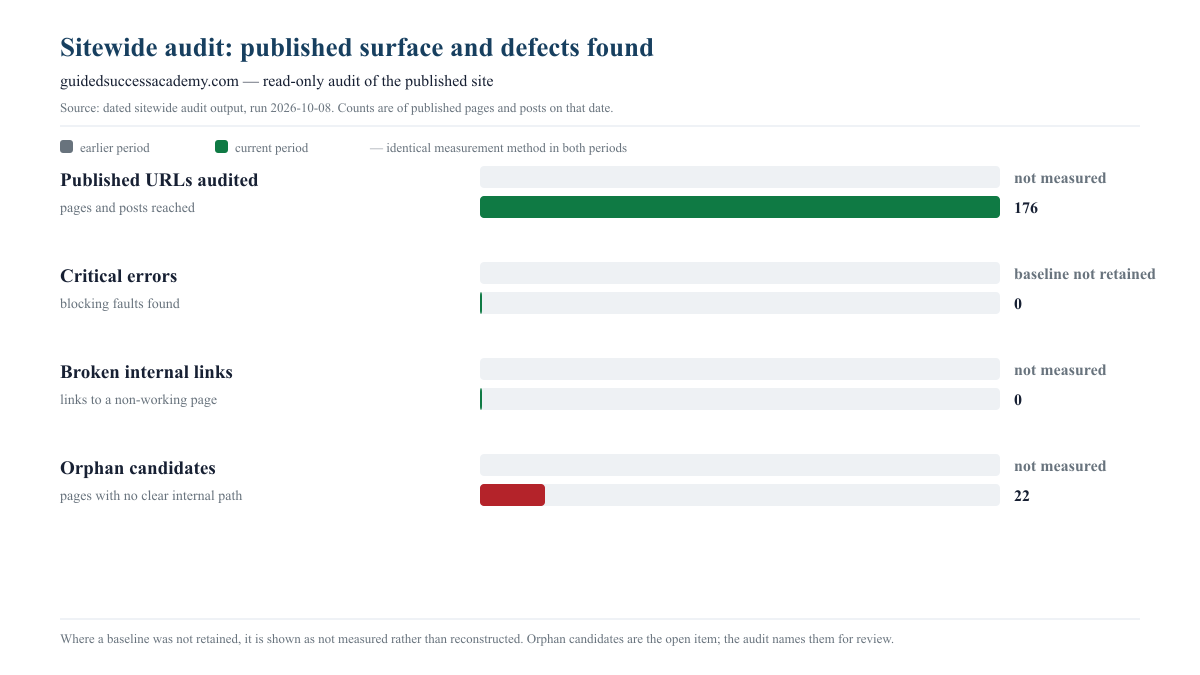
No pre-audit screenshot was archived. The audit itself is the baseline record, so the chart below carries the evidence rather than a reconstructed before image.
Next Decision
Decide which of the two or three city pages already closest to page one deserve concentrated support, based on the dated search window, before considering any wider internal-linking change — and fix the two H1 findings and two title-length findings as individual tasks.
- GSA sitewide crawl, 179 published URLs first-party read-only crawl; 2026-10-08
- GSA orphan-candidate list, 66 URLs by section first-party read-only crawl; 2026-10-08
- GSA sitemap and robots.txt coverage check first-party read-only crawl; 2026-10-08
- GSA /local-seo/ page impressions and clicks first-party Search Console read, 2026-07-09 to 2026-10-06; 2026-10-14
See which pages lose clicks
Run the free website SEO audit to find the pages Google already shows but that earn almost no clicks, then fix the highest-impact issues first.