

Average position is one of the most misread numbers in Google Search Console. A report may show an average position that looks encouraging, and someone may describe the page as “ranking” at that exact spot. Another report may show an average in the page-two range, leading to an automatic rewrite.
Direct answer
Search Console average position is an aggregated observation of where impressions were recorded for the selected page, query, and date range. It is not a fixed ranking that every searcher sees, and it is not a guarantee that a page appeared in the same place for every search.
Use average position as context for a page-and-query investigation. Narrow the report when the average is too broad, inspect the query and page relationship, and read clicks and CTR beside the position. Treat a page-two average as a reason to investigate, not as an automatic promise or rewrite order.
Why “ranking at position eight” is too simple
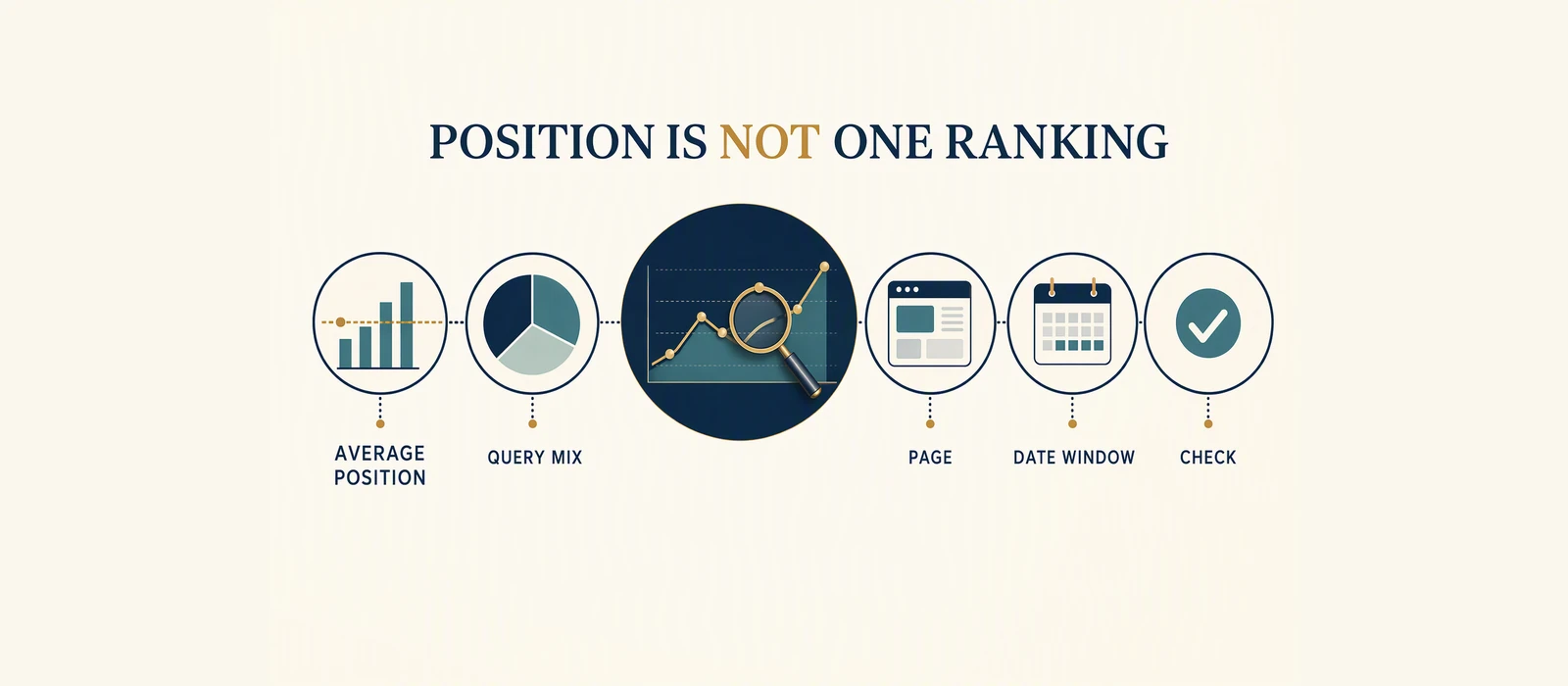
Search results are not one universal list experienced identically by everyone. The recorded position can vary with the query, device, location, timing, search features, and other context. Search Console groups observations so that you can analyse a period, but the average necessarily compresses variation.
An average of 8.4 does not mean the page occupied position 8.4 as a literal slot. It is a summary of the appearances included in that grouping. Some impressions may have been recorded in a different position. A page-level average may include multiple queries, each with a different intent and result context.
An average of 12.1 can be a useful near-page-one signal in the selected report, but it is not a first-page promise. Ask whether the page is the best answer for this intent and what action the evidence supports.
Read position with the other signals
Average position should not be read in isolation.
- Impressions show recorded appearances. They give the size of the observed visibility in the selected grouping, not the number of people who wanted the offer.
- Clicks show recorded selections. They are visits from search appearances, not leads or sales.
- CTR shows the relationship between clicks and impressions. It helps examine selection, but it does not explain the cause of a low or high rate.
- Page/query relationship shows which URL appeared for what search wording. This is the context needed to decide whether the visibility is relevant.
The page view can hide what an important query deserves. The query view can reveal several purposes. Use both before making a page decision.
Worked illustrative example
Worked illustrative example – anonymised GSA Growth demonstration. The figure is an observed report example used for education. It is not a ranking guarantee, forecast, or promise of page-one placement.
The supplied example contains 3,100 impressions, average position 12.1, and 0.29% CTR. It does not prove that the page was on page two for every searcher, nor that it was close to page one in every context. It is a grouped observation in a defined report window.
The row suggests a page-and-query relationship worth inspecting in a near-page-one reporting range. It does not tell you whether the right action is a title review, content refresh, internal linking, consolidation, technical investigation, or no change.
Open the page and query views. Check the query group, read the intent, compare the result with the page, and check for another URL with the same intent. Then document the next review and its limitation.
What average position can and cannot help you decide
It can add context to visibility
Position helps describe where recorded appearances occurred in the selected data. Combined with impressions and clicks, it can help you separate a page that is rarely seen from a page that is seen but seldom selected.
It can help you find a page-and-query question
A relevant query with a page-two average may justify inspecting the content answer, internal connections, and ownership. A rewrite is not automatic: the page could be thin, poorly connected, duplicated, incidental, unstable, or low priority.
It cannot predict a result
Position is not a promise about future visibility. It cannot tell you that an edit will move the page to a particular position. It cannot tell you how many clicks or business actions will follow.
It cannot replace intent
A high average for the wrong query is not necessarily valuable. A lower average for a relevant query may deserve review. The customer problem and page purpose matter as much as the summary.
A page-two decision without automatic rewrites
When a relevant query appears in positions 11 through 20 in the selected Search Console grouping, consider four possible decisions:
- Refresh when the answer is thin, stale, unclear, or missing an important part of the intent.
- Link when the page is relevant but not clearly connected from the site’s existing structure.
- Consolidate when multiple URLs overlap and no single page clearly owns the intent.
- Leave alone when the query is incidental, unstable, poorly aligned, or not important enough to justify a change.
This is a decision list, not a ranking formula. Position alone cannot choose the option; the page, query, intent, content answer, links, and dated comparison matter.
Compare like with like
Before comparing average position, record the property, page or query filter, date range, search type, and any relevant country or device view. Use comparable windows when investigating change.
An average can move because query mix, impressions, demand, competitors, seasonality, or technical conditions changed. A movement is an observation; the reason remains open until investigated.
Do not combine a page-level average from one window with a single-query average from another and call the difference a ranking loss. Keep the grouping visible.
Compare like with like
The safest comparison keeps the property, page or query scope and date window stable. A summary position can move because the query mix changed even when a specific page did not. Record the scope before interpreting the movement.
What the data does not prove
Average position does not prove a fixed rank, a page-one result, a future position, or a guaranteed click rate. It does not prove that every searcher saw the same result. It does not prove that the page is the best answer merely because the average looks high.
It also does not prove traffic, lead quality, sales, or revenue. A position change does not prove that a specific edit caused a business outcome. Search Console is one evidence source in a wider decision, not a promise engine.
The responsible conclusion is narrower: average position describes a grouped visibility observation. Use it to choose a better question, not to make a claim the report cannot support.
Checklist
- [ ] Record the property, page or query filter, and date range.
- [ ] Read average position with impressions, clicks, and CTR.
- [ ] Switch between Pages and Queries.
- [ ] Identify the intent behind the query or query group.
- [ ] Check whether the page is the intended owner of that intent.
- [ ] Inspect the rendered result and the page answer.
- [ ] For positions 11 through 20, consider refresh, link, consolidate, or leave alone.
- [ ] State what the comparison does not prove.
Optional next step
Use the free Website SEO Audit for a baseline. If you already have first-party Search Console history, review the Revenue-Leak Audit for page/query diagnosis.
For adjacent context, see the GSC audit case study.
Sources and Disclosure
This article uses dated consumer-facing evidence and clearly labelled teaching examples. Examples are directional, not forecasts or guarantees. No private client information, credentials or internal implementation details are included.
See which pages lose clicks
Run the free website SEO audit to find the pages Google already shows but that earn almost no clicks, then fix the highest-impact issues first.