
Home › Case studies › Case study library
SOVOR Sitewide SEO Audit: 160 Surfaces, One Open Gap
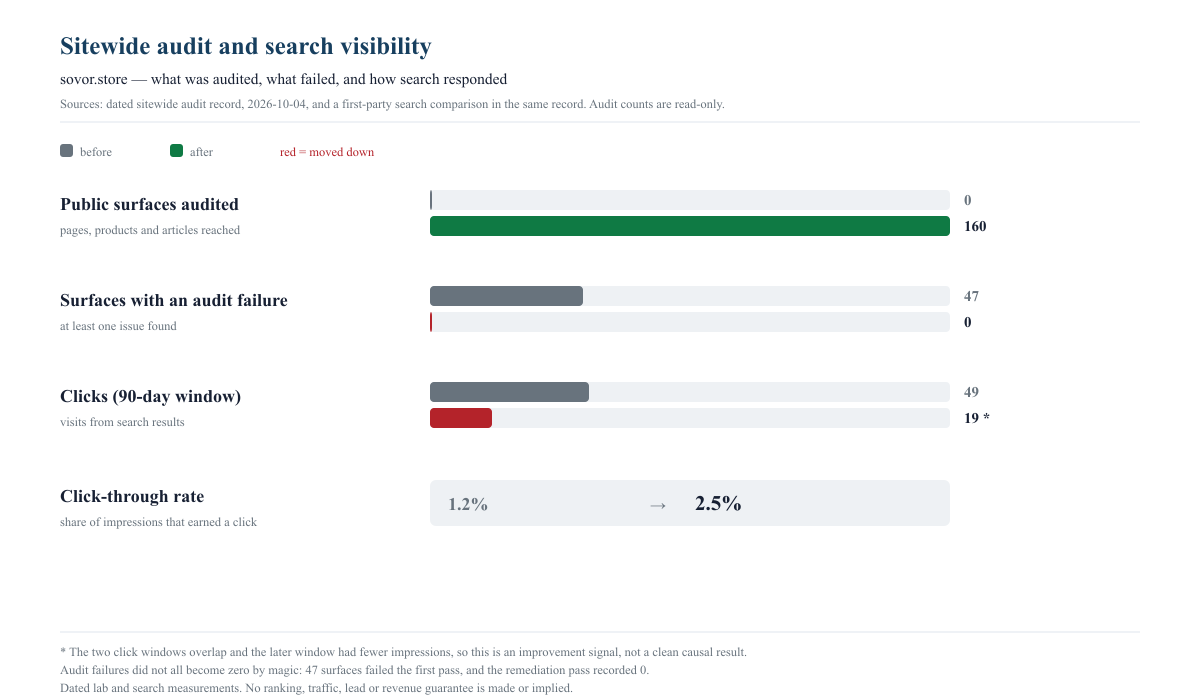
A dated audit of sovor.store covered 160 public surfaces — 89 Pages, 3 Products and 68 Articles. 47 surfaces had at least one failure on the first pass; by the final public-domain crawl, failures were zero across all three types. The more useful finding is what the audit could not resolve: the store’s main cash-on-delivery page is still reported by Search Console as unknown to Google.
Business Context
SOVOR is a Shopify storefront with three very different kinds of public surface. Pages include landing and utility content. Products are the commercial catalogue. Articles are the organic content layer, and at 68 of the 160 audited surfaces they are the largest part of the site. Each type has its own failure modes, which is why a sitewide audit on Shopify cannot treat the storefront as one uniform set of pages. A product title that is too long and an article canonical that is misconfigured are different problems with different fixes, and averaging them together hides both.
The Challenge
The audit had to produce one consistent view across Pages, Products and Articles while keeping the three distinguishable. It also had to draw a line that is easy to blur on a real store: the difference between a genuine technical failure that needs fixing and an early-growth condition that needs time. A legacy article with an over-long title is the first. A newly published article with no impressions yet is the second. Treating them as the same problem would have produced a long list of failures that were not failures, and buried the ones that were.
What Was in Scope
- 160 public surfaces: 89 Pages, 3 Products, and 68 Articles
- Titles, meta descriptions, headings, canonicals, structured data, and indexation
- Internal-link and content-depth observations
- A public-domain crawl of sovor.store, separated from the Shopify Admin host
- Dated Search Console windows for the store and for the COD cluster
- URL inspection coverage for the principal cash-on-delivery surfaces
Before and After at a Glance
A plain-language view of what was measured, what it looked like before, and what it looks like now. Each change is labelled so a score is never read on its own.
| The issue | Before | After |
|---|---|---|
| The size of the storefront surface checked89 Pages, 3 Products, 68 Articles. | 0 | ▲ Improved160SOVOR sitewide audit, public-domain crawl |
| How many surfaces failed at least one check47 on the first pass, zero on the final public crawl. | 47 | ▼ Lower0SOVOR sitewide audit, batched crawl |
| URLs the crawl could not verifyEvery surface in the final crawl was verified. | Not measured | ■ Unchanged0SOVOR sitewide audit, public-domain crawl |
| Whether the main cash-on-delivery page is known to GoogleSearch Console reports the hub URL is unknown to Google. | Not measured | ▼ LowerURL unknown to GoogleSearch Console URL inspection |
These are dated lab measurements, not a universal visitor experience. Read each row with its source and the limitations at the end of this report.
Evidence and Baseline
The audit is a dated, read-only crawl of the public storefront at sovor.store. The first pass was run against the development myshopify.com host and was discarded as an invalid public-site result — a correction worth recording, because a crawl run against the wrong host can look just as clean or just as broken as the real one. The corrected crawl used the public domain and completed with 160 surfaces audited and zero rate-limited URLs. Search Console figures come from dated windows ending 2026-10-03, and the COD cluster figures come from a filtered pull covering the same period. The two are reported separately because the store total and the COD subset measure different scopes.
Timeline
- First pass An initial crawl ran against the Shopify development host, found 47 failing surfaces, and was discarded as an invalid public-site result.
- Remediation Metadata, titles, templates, theme title tags, and utility-page indexation were corrected across the identified failure groups.
- Public-domain recrawl The corrected crawl of sovor.store completed across 160 surfaces with zero failures and zero rate-limited URLs.
- Coverage check URL inspection confirmed three COD URLs indexed and the principal COD hub still unknown to Google.
What the first pass found, and why it was thrown away
The first completed crawl audited the storefront through its Shopify development host rather than its public domain. It produced a result, but the result described the wrong thing: pages reached through a myshopify.com address are not the pages a search engine or a visitor sees.
That run was discarded rather than reported. The corrected crawl used https://sovor.store and completed with the same method against the public site. Recording the discarded pass matters, because it is a good illustration of a failure mode that no amount of careful analysis of the output would catch. The numbers were internally consistent. They were simply about the wrong host.
160 surfaces, three types, three failure patterns
The corrected crawl covered 160 public surfaces: 89 Pages, 3 Products and 68 Articles. Articles are more than 40% of the surface area, which shaped the whole result.
On the first full pass, 47 surfaces carried at least one failure. They were distributed across the three types: 17 of 89 Pages, 1 of 3 Products, and 29 of 68 Articles. Two things follow from that distribution. The Articles carried the majority of failures, and the Products — the commercially valuable surfaces — were the cleanest.
The failure groups themselves were specific. Legacy Article and Page titles fell outside the 51-to-60 character target. Two Pages emitted no detected structured data. One Product had a primary keyword mismatch between its title and its H1. Several utility, legal and support pages were thinner than the content-depth target. Two pages, one Page and one Article, carried a 320-character meta description. And a set of legacy cash-on-delivery articles needed title and metadata cleanup.
That list is worth reading for what it is not. None of it is exotic. It is the ordinary accumulation of a store that has published for a while — titles written for a different standard, a Product page whose keyword drifted away from its own H1, utility pages carrying less text than an editorial page would.
From 47 failures to zero
The remediation addressed each group on its own terms. 43 curated Page and Article metadata records were repaired. 44 published Article titles and summaries were normalised. The two custom product landing templates were corrected so they emit the right titles, descriptions and structured data. The theme was changed to use the actual article and product titles for the rendered title tag. Utility pages for newsletter, affiliate disclosure and thank-you flows were set to noindex. An accidentally published placeholder page was unpublished without deleting it.
The final public-domain crawl then reported zero failures across all 160 surfaces: 0 of 89 Pages, 0 of 3 Products, 0 of 68 Articles, with zero rate-limited URLs. The last two Article title-length failures were corrected and verified separately in the live rendered title field, and the audit parser was itself corrected to accept valid meta tags where an id attribute precedes the name attribute — a small but honest detail, since it means one of the initial failures was an artefact of the measuring tool rather than of the site.
Average internal links per surface were also recorded: 52.2 for Pages, 94.3 for Products, 58.6 for Articles. Those are descriptive, not a target. They tell you the store is interlinked, not that it is interlinked well.
The finding the audit could not close
Technical cleaning produced a zero-failure result. It did not produce traffic, and the audit was explicit that it would not. The Search Console picture tells a more complicated story than the crawl does.
For the full store, the 90-day window from 2026-07-04 to 2026-10-02 recorded 49 clicks, 4,033 impressions, a CTR of 1.2% and an average position of 13.6. The more recent 28-day window, 2026-09-05 to 2026-10-03, recorded 19 clicks on 758 impressions at 2.5% and position 7.2. Clicks, CTR and position all improved. Impressions fell. The windows overlap and the store was actively being edited throughout, so this is a directional improvement signal and not a clean before-and-after result.
The COD cluster is where the honest gap sits. Across six live cash-on-delivery URLs, the current 28-day window recorded a single impression on one query — ‘cod to prepaid conversions’, at position 11, with no click. The previous 28-day window recorded no COD impressions at all.
URL inspection then explained why. The commercial hub at /pages/cash-on-delivery-app-shopify is reported by Search Console as ‘URL is unknown to Google’, with a last-crawl date of never. Three other COD URLs are submitted and indexed. So the pages the audit could clean, it cleaned, and the single most commercially important COD page was never in the index to begin with.
This is the part of the report that matters most, because it is the part a technical score hides. A zero-failure crawl across 160 surfaces is true, and it sits alongside a commercial page that Google has never crawled. Both facts belong in the same report. Reporting only the first would make the store look finished when its central COD page is not even known to the index.
Why the store total is not the whole story
The store-level numbers and the COD numbers were pulled as separate scopes on purpose. The store total covers everything; the COD filter covers six URLs. A sitewide CTR of 2.5% says nothing about whether the COD pages are working, because the COD pages contribute almost none of the impressions that produce it.
That is a general lesson from this audit rather than a SOVOR-specific one. On a store where one section is strategically important but commercially early, the sitewide figures will be dominated by whatever else is performing. The only way to see the important section is to pull it separately, and then to accept what the separate pull shows — which here is an empty result for the part that matters most.
What this audit does not prove
Search Console movement cannot be attributed to a single page or a single change without controlled conditions, and the store was being edited throughout the measured period. No causal claim is made here.
The COD cluster remains early. Six URLs and one impression is not a performance dataset, and nothing in this report should be read as a COD result, positive or negative.
Technical audit completion does not prove rankings, leads, orders or revenue. A clean crawl means the surfaces are well-formed. It does not mean anyone found them, and it does not mean anyone bought anything. Those require separate measurement that this audit does not include.
Finally, backlinks were not measured. Shopify and Search Console search analytics do not expose a backlink inventory, so no claim about external links appears in this report.
What Improved
- One consistent audit view now covers Pages, Products and Articles, with the three types kept distinguishable rather than averaged.
- The 47 first-pass failures were reduced to zero on a corrected public-domain crawl, with the reasoning behind each group recorded.
- The audit explicitly separates genuine failures from early-growth conditions, so the report does not inflate the failure count.
- The COD cluster and the store total are measured as separate scopes, which is what exposed the unresolved commercial gap.
- The record includes the discarded development-host crawl, so the corrected method is transparent rather than presented as the only attempt.
What Remains Unresolved
- Search Console movement cannot be attributed to one page or one change without controlled conditions.
- The COD cluster remains early, with insufficient data for any performance claim.
- The main COD hub is still reported as unknown to Google, so the commercial layer is not indexed despite a clean technical crawl.
- Technical audit completion does not prove rankings, leads, orders, or revenue.
- Backlink quality was not measured, because neither Shopify nor Search Console exposes a backlink inventory.
Evidence Images
No pre-audit screenshot was archived. The initial failure count is retained from the measurement record and disclosed rather than illustrated with a reconstructed image.
Next Decision
Resolve the indexing status of the principal cash-on-delivery hub — which the cleaned crawl could not fix because the page was never in the index — before treating the COD cluster as a performance question rather than a coverage question.
- SOVOR sitewide crawl, 160 public surfaces first-party read-only crawl; 2026-10-05
- SOVOR Search Console, store and COD cluster, dated windows first-party Search Console read; 2026-10-03
- SOVOR URL inspection, COD coverage first-party Search Console inspection; 2026-10-05
See which pages lose clicks
Run the free website SEO audit to find the pages Google already shows but that earn almost no clicks, then fix the highest-impact issues first.