
Houston SEO Company: The Local Market Guide
If you are fourth in the Houston map, the customer sees three names and never sees you. This guide shows how Houston local SEO actually behaves: who is taking those calls, where the map is open, and what to fix first.
What you get: the 49-point market map, the near-miss list, and a first-fix plan you can use before you take a sales call.
GSA Growth · Remote local SEO for US businesses · 17 min read
HVAC · #1 at each of 49 points
40 of 49 points held by one business. The map is not a level field.
Free · 13 pages
The full Houston study, without the sales call
Top-10 tables, near-miss maps, demand and the first fixes. Email it to yourself. The download link is sent to your inbox.
In this guide
Trade guides
Houston local SEO: the market in one table
We recorded the public local results for four Houston searches on 1 November 2026. For each trade we recorded the top ten businesses at 49 points across central Houston. That produced 1,960 top-ten observations and 333 unique businesses.
| Trade | Leader | Top-3 points | Firsts (#1) | Reviews | Businesses in top 3 | Top-3 concentration |
|---|---|---|---|---|---|---|
| HVAC | Air Tech of Houston AC & Plumbing | 49/49 | 40 | 6,665 | 17 | 61.2% |
| Roofing | Precision Roof Crafters, Inc. | 33/49 | 18 | 473 | 26 | 53.1% |
| Plumbing | Houston Plumbing Services | 41/49 | 27 | 242 | 19 | 56.5% |
| Dentistry | Urgent Dental Care of Houston | 27/49 | 14 | 1,406 | 70 | 32.7% |
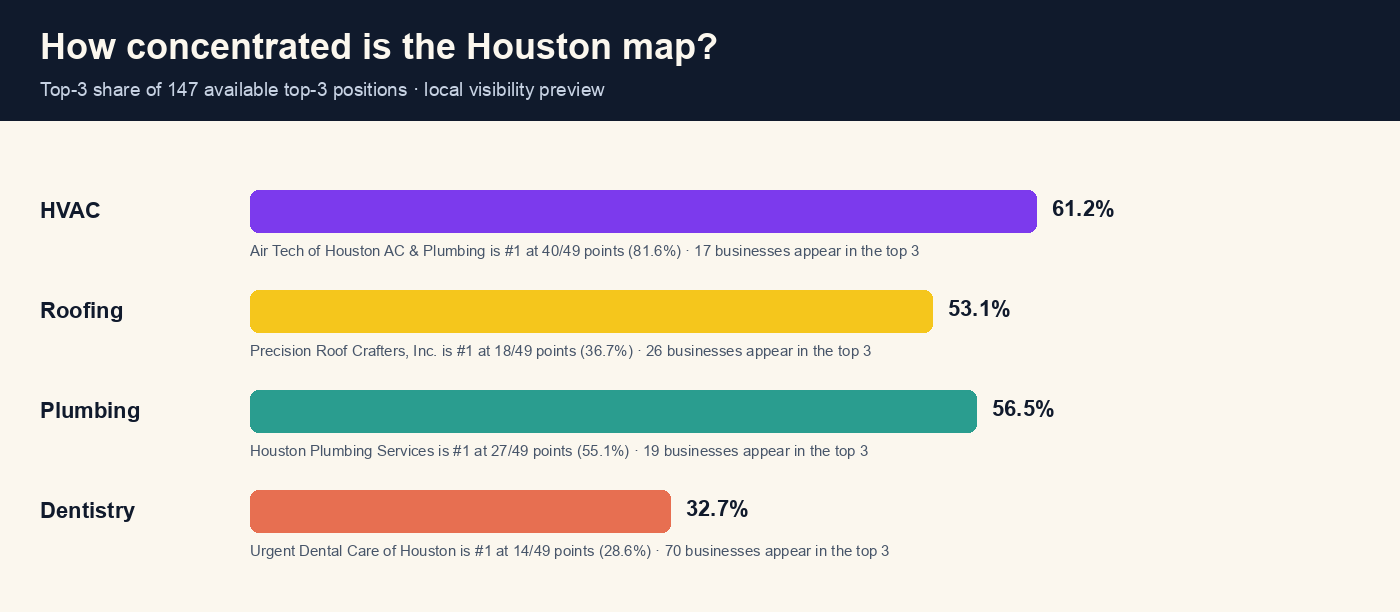
The table is not a ranking of the best businesses in Houston. It is a map of who owns the visible shelf. The leader in HVAC appears at every one of the 49 points and holds first at 40 of them. The leader in dentistry appears at 27 points and holds first at 14. Both are strong results, but they describe different markets.
That difference matters before you spend money. A single city-wide strategy assumes one hill to climb. Houston has several hills, and the gradient changes by trade, by neighbourhood and by the service someone searches for.
Demand without access is just traffic
Demand tells you whether a market is worth entering. Concentration tells you whether the front of the market is open. You need both before you decide where to compete.
| Trade | Directional monthly demand | Top-3 concentration | Businesses in top 3 | Leader #1s |
|---|---|---|---|---|
| Dentistry | 135,000–183,000 | 32.7% | 70 | 14 |
| Plumbing | 30,000–41,000 | 56.5% | 19 | 27 |
| Roofing | 9,000–13,000 | 53.1% | 26 | 18 |
| HVAC | 48,000–65,000 | 61.2% | 17 | 40 |
Dentistry has the largest demand and the most open top three. That combination is unusual. It means a practice does not need to beat one dominant profile across the whole city to become visible; it needs to become the best answer in the localities where its patients actually search. Plumbing has less demand than dentistry but a more closed front. HVAC has strong demand and the most concentrated top three. Roofing has the smallest demand range in this set, but the local result still changes block by block.
This is why “Houston SEO” is too broad a brief. The useful question is not “How do I rank in Houston?” It is “Which service, in which part of Houston, has enough demand and an open enough top three to justify the work?”
The fourth-place problem
The top three get the first comparison. The fourth business is already visible to some customers, but at the points where it sits outside the top three it is not in the shortlist. That is the most realistic growth list in Houston.
| Trade | Businesses at #4 or #5 somewhere | Near-miss points | Points where #4 has more reviews than #3 | Average #3–#4 review gap |
|---|---|---|---|---|
| Dentistry | 64 | 98 | 24 | −37.0 |
| Plumbing | 25 | 98 | 23 | −731.5 |
| Roofing | 27 | 98 | 17 | −401.6 |
| HVAC | 28 | 98 | 16 | −244.7 |
The fourth-place business is not a failure. It is already close enough to be shown to some customers, which means the profile has enough relevance to compete. The gap is usually a mix of proximity, category clarity, review recency, service-page relevance and the strength of the landing page behind the profile.
Dentistry is the clearest example of how little the review count can explain on its own. At 24 of the 49 search points, the fourth-ranked practice had more reviews than the third-ranked practice and still ranked lower. The average gap between third and fourth was only 37 reviews. A practice with a strong local page and a clear service focus can close that without trying to match a 1,400-review competitor across the city.
Plumbing shows the opposite pattern. At 23 points the fourth-ranked business had more reviews than the third, but the average review gap was 731. The review count is not a simple switch. It is one signal among several, and it behaves differently depending on the query, the location and the profile.
Why the four trades behave differently
The same city can produce a fortress in one trade and a revolving door in another. These are the patterns in the data, not proof of a single cause.
HVAC: the fortress
One business appears at all 49 points and holds first at 40. The top three take 61.2% of the available top-3 positions. Breaking the whole city is a long game; winning a locality or a service niche is more realistic.
Roofing: local and seasonal
The leader appears at 33 of 49 points. The top three take 53.1%, and 27 businesses sit at fourth or fifth somewhere. The result is local enough that a suburb-level page can matter, especially around storm and repair demand.
Plumbing: reviews are not enough
The leader appears at 41 points, but at 23 of the 49 search points the fourth business has more reviews than the third. Profile completeness and service relevance are doing work that a review count alone cannot explain.
Dentistry: the open market
The top three take only 32.7%, and 70 different practices appear in the top three somewhere. The leader holds 27 points. This is the most testable market for a locality-first strategy.
The practical lesson is not “pick the easiest trade.” It is “match the strategy to the shape of the market.” A dental practice can test a neighbourhood page and a service page in weeks. An HVAC company may need to win a smaller service area first, then expand. A roofer may get more from storm-season content and suburb pages than from a generic city page. A plumber may get more from fixing the profile and the service mix than from adding reviews.
What the top three have in common
The leaders are not always the biggest brands or the businesses with the most reviews. They are the businesses that best match the query, the location and the moment. The pattern usually includes several of these, not one.
- A clear primary category. The profile says what the business is before the customer has to infer it.
- Services that match the query. The service list and the landing page describe the same work in the same language.
- Recent, relevant reviews. Reviews mention the service and the area, not just the business name.
- Proximity and prominence. The business is close enough to the searcher and well known enough to be a plausible choice.
- A page that confirms the profile. The landing page delivers the service, the area, the proof and a clear next step.
- Consistent public details. Name, address, phone and hours agree across the profile and the directories that matter.
- Enough local proof. Supplier pages, trade associations, sponsorships, local press and real case studies all help.
The top three are also not a permanent group. In dentistry, 70 different practices appear in the top three at least once. In plumbing, 19 do. The composition changes with the point on the map. That is why a single screenshot is a weak diagnosis and a grid is a better one.
Where the map changes
A city-wide rank is an average of many local results. Customers do not search an average; they search from a place.
The 49 points in this study sit across central Houston and the surrounding commercial districts. The same business can appear first at one point and outside the top ten a few miles away. That is not a glitch. It is how local search works: proximity, the query, the profile and the competition all change with the location of the search.
This is why neighbourhood pages should follow demand, not a list of postcodes. A page for a neighbourhood with no search demand is a thin page with a map on it. A page for a service that people actually search, in an area where the business can realistically compete, is a useful asset. The same rule applies to suburbs such as Katy, Sugar Land, Pearland, The Woodlands, Spring, Cypress, Bellaire, Pasadena and League City. The page should exist because the demand and the competition justify it, not because the city name is available.
The practical test is simple. If you removed the neighbourhood name, would the page still answer a real question? If not, it is probably a doorway page. If it would, it is probably worth building.
“A single screenshot is one point on one day. The distribution is the evidence.”
What actually moves a Houston business
Local visibility is built from several signals that have to agree. A single fix rarely changes the map on its own, and a single screenshot rarely explains why.
1. Profile clarity
The primary category, secondary categories, services, service area, hours, photos and Q&A should tell one coherent story. A profile that lists every service under the sun makes it harder for Google to understand what the business is best at. A focused profile is easier to match to a focused query.
2. Review recency and relevance
Reviews are a trust signal and a relevance signal. A large review count helps, but recent reviews that mention the service and the area are more useful than a stale pile of generic ratings. The request process should be legitimate, and the response should be consistent. Buying reviews or gating them behind a rating is a risk, not a shortcut.
3. Pages that match the query
A service page should answer the question the customer typed. A locality page should add real local context: the areas served, the jobs completed, the questions customers ask and the proof that the business operates there. A page that swaps the city name into the same template is not a local page. It is a doorway page with a new label.
4. Citations and public details
Name, address, phone and hours should agree across the profile and the directories that matter. Inconsistent details create doubt for customers and noise for search engines. The goal is not to be on every directory; it is to be correct on the ones that are actually used.
5. Local links and proof
Local links are earned through real relationships: supplier pages, trade associations, sponsorships, local press, community work and customer stories. A link from a relevant Houston organisation is worth more than a hundred generic directory listings. The proof should be visible on the page, not just in a spreadsheet.
6. Measurement that survives scrutiny
Use the same grid, the same query and the same radius before and after the work. Record the date, the device and the surface being measured. If a provider only shows a screenshot of one result, ask what it represents. A single point is not a city-wide rank.
The map pack is not the whole website problem
A business can own the map and still lose the searches that never show a map. The website is the second channel: local organic, conversion and the page behind the listing.
The shortlist
Google Business Profile, reviews, proximity and category decide who appears in the three-pack.
The second shortlist
Service and city pages win the searches below the map, the non-emergency research and the long tail.
The conversion layer
Speed, proof, clarity, calls and forms decide whether the map click becomes a job.
Both systems matter. The sequence is the strategy.
| Layer | What wins it | What it produces | Speed | What it misses |
|---|---|---|---|---|
| Map pack | GBP, proximity, reviews, category, prominence | Urgent local calls and direction requests | GBP changes can move in weeks; reviews take months | Research, long-tail and the queries that never show a map |
| Local organic | Service pages, city pages, content, links, technical health | Non-map clicks, research traffic and AI citations | Title changes take weeks; new pages take months | The urgent “near me” moment, where the map takes the click |
| Website | Speed, proof, clarity, booking path, trust | Calls and forms from both channels | Immediate for conversion; continuous for trust | Visibility. A good site does not create a map pack or an organic ranking by itself. |
That is why a 55/100 website can sit behind a dominant map profile. The map may still deliver calls, but the site is losing the non-map clicks and some of the clicks it already gets. The top players are not equally strong at all three layers.
Website SEO is not a replacement for the map. It is the layer that makes the map worth more: more organic entries, better conversion and less dependence on paid clicks.
Five mistakes that waste a Houston local SEO budget
Most local SEO failure is not a mysterious algorithm problem. It is a sequence problem: the wrong market, the wrong diagnosis, or five changes made at once with no way to tell which one worked.
1. Treating Houston as one location
Houston is too large for a single city-wide rank to mean much. A business can be first in one part of the city and invisible in another. If the plan does not say which points, which service and which competitor set it is trying to change, it is not a plan. It is a wish with a map attached.
2. Chasing the review count and nothing else
Reviews matter, but they are not a simple threshold. In dentistry, the fourth-ranked practice had more reviews than the third at 24 of the 49 search points. In plumbing, it happened at 23 of the 49. The profile category, the service list, the landing page and the proximity are doing work that a review count cannot explain on its own.
3. Building city-name pages with no local proof
A page that swaps “Houston” for “Katy” and changes the H1 is a doorway page. It gives the reader no reason to believe the business works there. A useful local page adds real context: the jobs, the questions, the areas served and the proof. If the page would be meaningless without the place name, it probably should not exist.
4. Measuring one screenshot
A screenshot is one point on one day. It may be a real result, but it is not a city-wide rank. Use a grid, state the radius and the date, and compare the same points before and after. The distribution is the evidence. A single “#1” image is a marketing asset, not a diagnosis.
5. Changing five things at once
If the profile, the page, the reviews, the citations and the links all change in the same week, the movement cannot be attributed. Fix the foundation first, then the page, then the proof. Measure the delta. Keep what moves; cut what does not. That is slower to describe and much faster to learn from.
What to fix first
If you are starting from a weak local presence, the order matters more than the volume of activity. Fix the foundation before adding pages; fix the pages before adding links.
1. Confirm the market
Choose one service and one priority area with enough demand and a realistic path into the top three. Do not start with “all of Houston”.
2. Fix the profile
Correct the category, services, service area, hours, photos and Q&A. Make the business easy to understand.
3. Build one useful page
Create the service or locality page that matches the query. Add real proof, service details and a clear next step.
4. Build the review habit
Ask every customer through a legitimate process. Respond to reviews. Keep the recent reviews relevant to the work you want.
5. Measure the delta
Re-run the same grid at 30, 60 and 90 days. Keep what moves; cut what does not. Do not change five things at once and guess.
A realistic 90-day test is not “rank first by Friday”. It is: fix the profile in week one, publish one useful page in weeks two and three, start a legitimate review routine, then re-run the same grid at 30, 60 and 90 days. If the distribution does not move, change the diagnosis, not the promise.
How to choose a Houston SEO company
The questions matter more than the pitch. A provider who can explain the method, the limits and the measurement is usually a better bet than one who promises a position.
- Ask for the grid. How many points, what radius, what date, what device? A single rank is not a market.
- Ask which competitors they measured. A local audit without a named competitor set is a screenshot with a story.
- Ask which surface they measured. Google Maps, the Search local pack and third-party grids are not the same thing.
- Ask what they will change. Profile, reviews, pages, citations, links and technical work should be separated, not bundled into “SEO”.
- Ask for a before-and-after grid. Not a single “#1” screenshot. The distribution is the evidence.
- Ask about review policy. No fake reviews, no review gating, no incentives that break the platform rules.
- Ask about local pages. A real page has local proof. A city-name swap is a doorway page.
- Ask who does the work. The person in the sales call is not always the person editing the profile or writing the page.
- Ask what happens if the work does not move. A good provider has a diagnosis, not an excuse.
A provider should be comfortable saying “we do not know yet” and then explaining how they will find out. Local search is measurable. The method should be visible before the invoice.
How we measured
The numbers on this page come from a fixed grid, a fixed query set and one collection date. The method is stated so the result can be checked and challenged.
- Grid: 49 points across central Houston.
- Queries: four trade searches — HVAC, roofing, plumbing and dentistry.
- Date: 1 November 2026.
- Depth: top ten businesses at each point.
- Observations: 1,960 top-ten positions across the four trades.
- Businesses: 333 unique businesses observed.
We did not personalise the results. Local results still vary by location, device, language, search history, time and the surface being measured. Google Maps, the Google Search local pack and third-party tools can disagree because they measure different surfaces and different points. The figures here are directional evidence, not a permanent ranking or a promise of calls.
Top-3 concentration is the share of the 147 available top-3 positions held by the three leading businesses in a category. A high number means a closed category. A low number means the top three changes more often. It does not mean the leader holds that share.
Houston local SEO questions
What is local SEO in Houston?
Local SEO is the work of making a business visible in the local results for the services and areas it serves. In Houston that means the Google Business Profile, reviews, service and locality pages, citations, local links and the measurement of where the business appears across the city.
How much does local SEO cost in Houston?
Cost depends on the service, the competition, the number of locations and whether the work is a one-off audit, a fixed sprint or ongoing implementation. A dated audit is the cleanest first step because it shows the size of the gap before anyone commits to a monthly programme. Implementation should be scoped after the diagnosis, not before it.
How long does it take to rank in the Houston Map Pack?
It depends on the category, the locality, the profile history, the reviews and the competition. Profile and citation corrections often move before content and reviews do. We do not guarantee a timeline or a position.
Do you guarantee a top-three position?
No. Local results vary by location, device, language, search history and measurement method. A provider who guarantees a position is either measuring one point or ignoring the variation. The work can be guaranteed; the position cannot.
Why do different tools show different rankings?
Google Maps, the Search local pack and third-party grids are different surfaces. They use different locations, devices, personalisation and collection methods. A single screenshot is one point on one day, not a city-wide rank. The grid, the radius and the date matter as much as the number.
Do reviews guarantee a top-three position?
No. Reviews are a trust and relevance signal, but they are not the only signal. In dentistry, the fourth-ranked practice had more reviews than the third at 24 of the 49 search points. Proximity, category, services and the landing page also matter.
Do I need a Houston office to rank in Houston?
No. A business can serve Houston without a fake address. The profile should describe the real service area, and the pages should prove real work in the area. A virtual office or a borrowed address is a risk, not a shortcut.
How often should I measure local visibility?
Measure before the work, then at 30, 60 and 90 days. After that, monthly or quarterly is enough for most local businesses. Use the same grid and the same query so the comparison is honest.
What should I ask a Houston SEO company?
Ask for the grid size, radius, date and device; the competitor set; the surface being measured; the specific changes they will make; a before-and-after grid; their review policy; and who will do the work. The answers should be specific enough to check.