
Direct answer: A travel agency does not need more generic “travel” pages. It needs one page for each trip intent it can actually serve: a destination, a package type, a season or a group. The page should answer the trip question before it asks for the enquiry.
Who this is for
This is for a travel agency owner who is deciding whether to add more pages or fix the ones already published. It is not a traveller’s itinerary guide. The question is which trip intent the agency can own first.
Why “travel agency in Dehradun” is not enough
The head query gets the first look. It does not answer “which trip?” A buyer planning a pilgrimage, a family holiday, a school trip or a corporate offsite has different questions. A single page that tries to answer all of them becomes a brochure that ranks for none of them well.
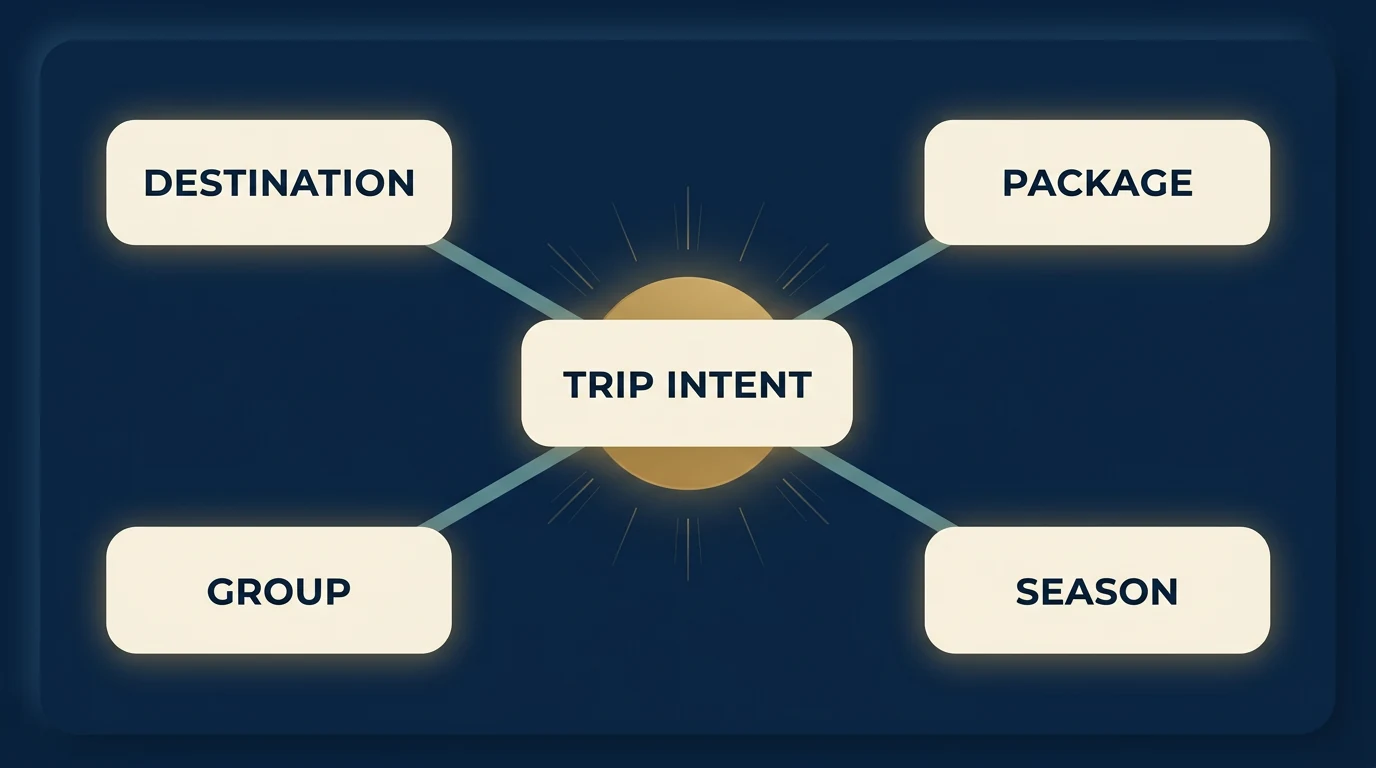
At a glance: intent beats volume
| Page type | Query it owns | What the buyer needs | What it cannot prove |
|---|---|---|---|
| Destination page | “Dehradun to [destination] package” | Route, duration, stay, inclusions | That the trip is available on every date |
| Package page | “pilgrimage package from Dehradun” | Itinerary, transport, support | That the price is the lowest |
| Group page | “school trip / corporate offsite” | Group terms, safety, invoicing | That a retail package fits |
| Season page | “Dehradun travel in [season]” | Weather, access, what changes | That the same itinerary works all year |
Decision table: what to build first
| If you are… | First check | Do not assume | Next action |
|---|---|---|---|
| A small agency | Which trip intent produces the best enquiries | Every destination needs a page | Build the one you can serve best |
| A pilgrimage specialist | Route and season demand | A generic holiday page will rank | Build one route page with proof |
| A corporate travel desk | Group terms and response time | Retail package copy is enough | Add group-specific proof |
| A new agency | Which query has demand but weak answers | You need a full catalogue first | Start with one honest page |
What the demand estimate says
Third-party keyword estimates about 1,900 monthly searches for “travel agency in Dehradun.” “Travel agency SEO in Dehradun” is the service longtail, not the trip demand. The service page can explain the method; the trip pages must own the destinations and packages.
What a trip page must include
A trip page has one job: answer the trip question well enough that the buyer does not need another tab.
- Route: the actual sequence, not a vague destination list.
- Duration: days, nights and the time needed at each stop.
- Stay: the type of accommodation, not a promise of a specific hotel unless confirmed.
- Transport: pickup, vehicle type and what happens at each transfer.
- Inclusions and exclusions: the fields that change the final price.
- Group fit: age, mobility and group-size limits.
- Next step: a clear request path and a response expectation.
If the page only says “contact us for the package,” it has not answered the query. It has moved the work back to the buyer.
What to measure
Track each trip page against the query it owns. Record impressions, clicks and qualified enquiries. A page with impressions but no clicks is a selection problem; a page with clicks but no enquiries is a next-step problem. Do not compare a destination page with a service page and call the difference a ranking result.
The catch
Package demand is fragmented. A destination may have low volume and still produce valuable enquiries. A high-volume destination may be dominated by national platforms. The page decision should use both demand and the agency’s ability to serve the trip.
Free check: map five queries to five pages
- List five trips your agency can actually deliver.
- Write the query a buyer would use for each.
- Search each query and record the winning page type.
- Mark which query has no strong local answer.
- Build that page first.
Common mistakes
- Building a page for every destination before serving one well. Coverage is not the same as usefulness.
- Copying the same itinerary across routes. The buyer can see that the page is not about the trip.
- Hiding the exclusions. The price looks lower until the buyer asks.
- Using a national platform’s tone. A local agency wins on local response and specific trip knowledge.
- Measuring page count instead of enquiries. More pages do not fix a weak answer.
The first page should be the trip the agency can serve best, not the destination with the biggest headline volume.
FAQ
How many pages does a travel agency need?
Enough to cover the trips it can serve well. There is no fixed number.
Should we target every destination?
No. Target the destinations where you have a real offer and a useful answer.
Do package pages need prices?
They need a price range or a clear “request a quote” path. A fake exact price is worse than a range.
Can a service page rank for trip queries?
Rarely well. The service page explains SEO; the trip page answers the trip.
Is this a booking guarantee?
No. It is a page-ownership decision.
Related
Demand figures are third-party estimates. Package availability changes. No ranking or booking guarantee is made.