
Read an SEO audit report as an evidence record, not as a scorecard. Start by asking what was measured, where it was measured, when it was measured and under what conditions. Then separate the observation from the interpretation, identify the action it supports, and write down what remains unknown.
This approach prevents two common mistakes. The first is treating every warning as equally urgent. The second is turning a clean technical result into a ranking, traffic or revenue promise. A good report can contain useful findings and important limits at the same time.
Direct answer
Use this seven-field reading frame for any SEO audit report:
- What was measured? Identify whether the line refers to a URL, page element, link, crawl condition, Search Console metric, analytics event or business result.
- Where was it measured? Note the property, URL set, template, page group, country or authorized account scope.
- When was it measured? Put the run date or comparison window beside the number.
- Under what conditions? Record device, rendering, filters, access and any major site or architecture changes that affect the reading.
- What was observed? Describe the result without adding a cause that the report did not test.
- What action follows? Choose a verification, correction, consolidation, measurement or editorial decision.
- What remains unknown? Preserve questions about causation, rankings, visitors, enquiries and business outcomes.
If a report cannot answer the first four questions, its recommendations need more context before you rely on them. If it cannot distinguish observations from explanations, read the conclusions cautiously.
Core explanation
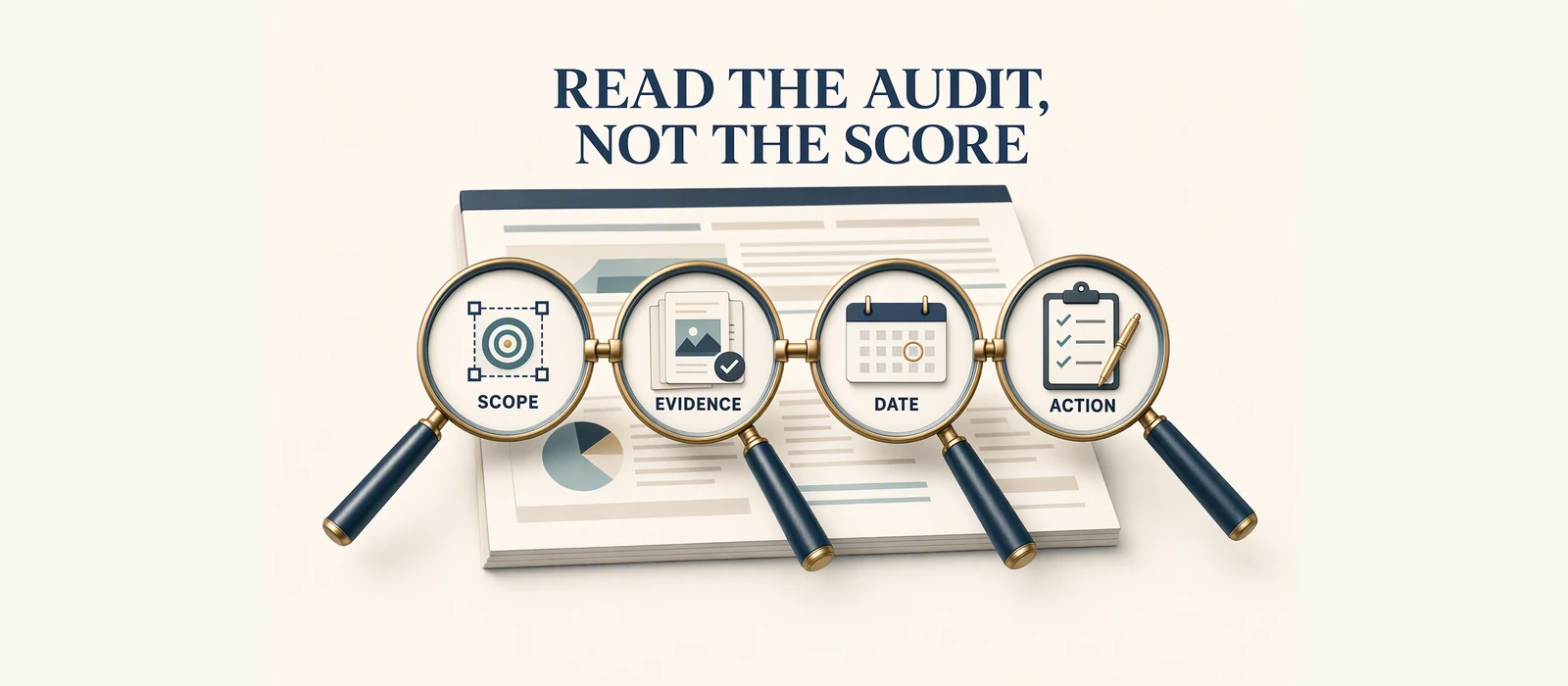
An audit report normally contains several kinds of information. The first is scope. Scope tells you whether the report covers one landing page, a set of templates, a whole public site or a Search Console property. A result about 20 selected URLs should not be described as a result about every URL on a domain.
The second is evidence. Evidence may be a rendered title, a response signal, a canonical, a broken internal link, a page heading, an indexed state or a dated Search Console metric. Read the evidence in its original category. A technical field and a search-performance field do not answer the same question.
The third is interpretation. Interpretation explains why the observation may matter. It should be written as a bounded possibility when the report does not establish causation. For example, a page with impressions and a low CTR may deserve a title and query-fit review. That observation does not prove that the title is the cause.
The fourth is priority. Priority should reflect consequence, relevance, confidence and the ability to verify the next step. A page that cannot be reached may deserve earlier attention than a minor advisory warning. A high count of low-impact warnings does not automatically outrank one issue affecting an important service path.
The fifth is ownership. A recommendation should make clear whether an editor, developer, business owner or measurement owner needs to decide. Without an owner, a report becomes a list of observations that no one can safely act on.
When a report gives you a single SEO score, use the score as a navigation aid at most. Find the observations underneath it. A score can compress different categories into one number and hide the difference between a blocker, an advisory note and an opportunity. If the report does not show the underlying categories, request them before making a major change.
Worked example
GSA has an approved first-party sitewide audit example that shows why this reading habit matters. The public report covered the guidedsuccessacademy.com property on a dated run recorded as 5 October 2026. The audited scope contained 176 published URLs. In that scope, the report recorded 0 critical errors and 0 broken internal links, while also identifying pages that may be hard to discover that required separate interpretation.
Read the example one field at a time. What was measured? A defined public URL scope and technical categories including page, link and structural conditions. Where? The GSA sitewide property and its published URL set, not every future page or every business system. When? The dated report run of 5 October 2026. Under what conditions? The public published surface available in that run, with Search Console treated as a separate evidence category where available.
What was observed? The critical technical error count and broken-link count were both zero in the audited scope. Pages that may be hard to discover were present as items needing editorial and navigation review. What action follows? Preserve the clean technical baseline, review the candidates by page purpose and discovery, and compare the same scope after a meaningful site change. What remains unknown? The audit does not establish that every page ranks, that every warning is irrelevant, or that the baseline produced a particular business outcome.
The same report therefore supports a positive and a cautious statement. It supports saying that the checked public scope had no recorded critical errors or broken internal links in that run. It does not support saying that the whole site is perfect, that all pages are equally strong, or that technical cleanliness caused more traffic or revenue.
The orphan-candidate detail is especially useful. A candidate is not automatically a defect. A page may be intentionally narrow, newly created, useful from a campaign or awaiting an editorial decision. The right question is whether the page has a purpose and an appropriate discovery path, not whether every URL must receive more links.
This is what a mixed report can look like: a clean critical layer alongside editorial opportunities and separate search evidence. Do not force all of those layers into one headline.
Practical inspection method
Use the following report-reading method when a provider, colleague or tool gives you an audit.
- Read the cover fields. Record property, scope, report date, comparison window and access conditions.
- Sort findings by evidence type. Keep crawl and page findings separate from Search Console, analytics, review or revenue evidence.
- Open representative pages. Verify important findings on the rendered page. A CMS field or report row may not match what a visitor sees.
- Check the page role. Ask whether the URL is a hub, service page, supporting guide, utility page or another intentional type.
- Translate the finding into a question. Replace “fix all warnings” with “which important page or visitor decision does this observation affect?”
- Choose a bounded action. Prefer a clear verification or targeted correction over a whole-site rewrite based on one score.
- Record the test. State what should be checked after the change and which date or scope will be compared.
- Keep the boundary attached. Carry the limitation into the summary so a later reader does not mistake an observation for a guarantee.
If two sections conflict, check scope and dates first. A technical report can be clean while Search Console movement is mixed. A page can be technically accessible while its title fails to earn a click. A report is not contradictory merely because the categories point to different next questions.
What the data does not prove
An SEO audit report does not prove a ranking position for every searcher, future traffic, lead volume, sales or revenue. A zero-error result does not prove that every page is relevant, useful, indexed, selected or commercially effective. A page that may be hard to discover does not prove that a page is broken.
A Search Console comparison does not prove causation. A movement in impressions, clicks, CTR or average position may be affected by demand, query mix, seasonality, competition, architecture changes, content changes and other conditions. A report can describe movement without claiming why it happened.
Public-page evidence also does not reveal private visitor intent. A missing phone number in the inspected view is a clarity question; it is not proof that nobody could contact the business. A review count is public proof context; it is not appointment or revenue data. Keep the evidence boundary beside the conclusion.
Checklist
- [ ] What was measured?
- [ ] Where was it measured?
- [ ] What date or comparison window applies?
- [ ] What conditions or site changes affect the reading?
- [ ] Which findings are technical, editorial, search or business evidence?
- [ ] What observation is directly supported?
- [ ] What action follows, and who owns it?
- [ ] What should be verified later?
- [ ] What remains unknown?
- [ ] Does the summary avoid ranking, traffic, lead, sales and revenue guarantees?
Optional next step
Use the SEO audit education hub for related audit concepts. For a reusable reporting structure, see the SEO audit report template. If you need a defined scope and delivery, review SEO Audit Services. The GSA case studies hub provides additional evidence-led context.
Sources and limits
This article uses dated consumer-facing evidence and clearly labelled teaching examples. Examples are directional, not forecasts or guarantees. No private client information, credentials or internal implementation details are included.
Related
- Search Visibility and Audit Literacy hub
- What a Good SEO Recommendation Should Show You
- Average Position vs Ranking: What Search Console Really Shows
Dated guidance. No ranking, traffic or revenue guarantee.
Choose the next step
Compare the fixed-scope options or book a fit call.
See which pages lose clicks
Run the free website SEO audit to find the pages Google already shows but that earn almost no clicks, then fix the highest-impact issues first.