
An ecommerce marketing plan should not begin with a list of platforms. It should begin with the customer journey and the question each channel is expected to answer.
SEO can build discoverability over time. Google Ads can buy controlled access to search demand. Meta Ads can test creative, audiences and remarketing. Email can help a known customer return. Content can explain a category, product or decision before a visitor is ready to buy.
The strongest system connects these channels without pretending that an impression, click or engagement is a sale.
Direct answer
Use SEO for durable search visibility, Google Ads for controlled high-intent experiments, Meta Ads for audience and creative learning, email for owned customer relationships, and content to answer the questions that help a buyer choose.
Do not launch every channel at once. Give each channel one job, one landing path, one conversion definition and one review date.
The channel map
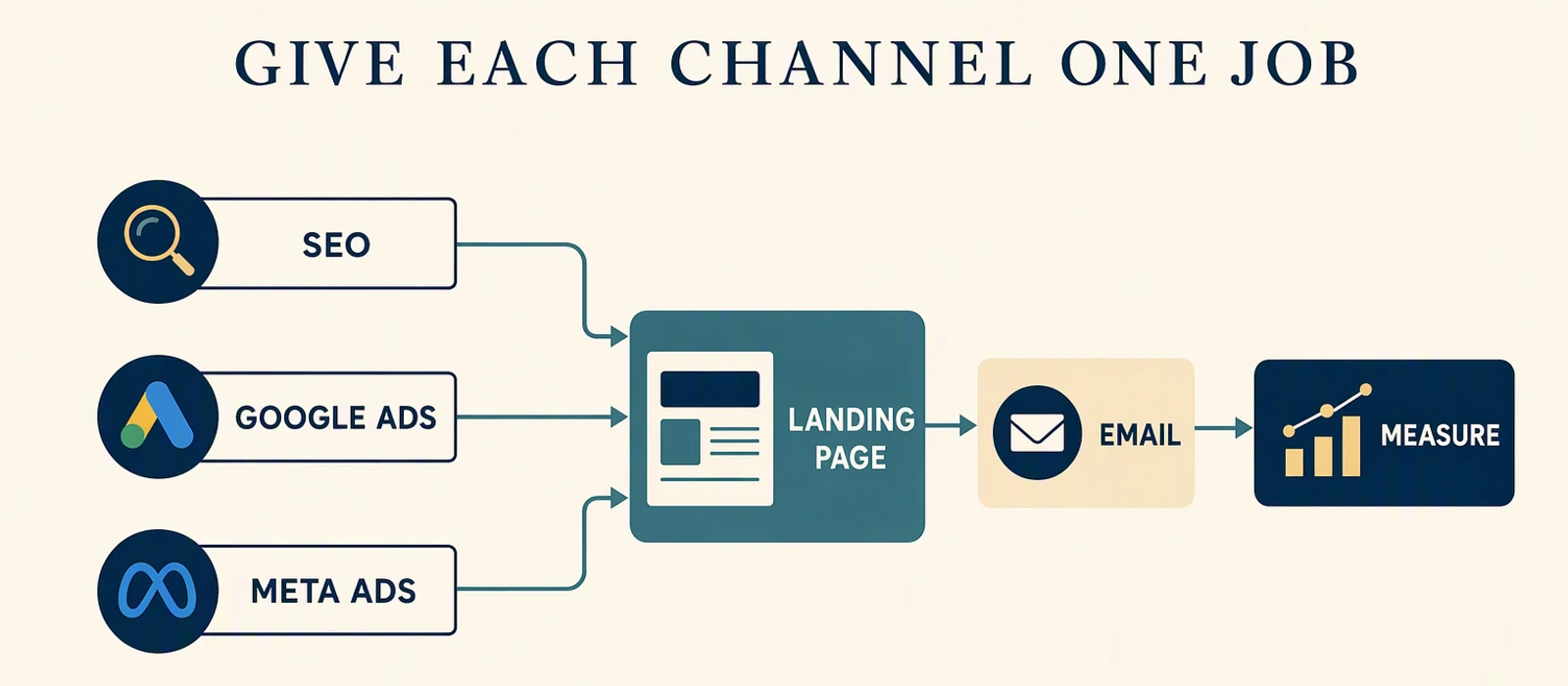
| Channel | Best first question | Main destination | Useful signal |
|---|---|---|---|
| SEO | Can the right page be found for a relevant search? | Category, product or guide | Impressions, queries, clicks and page selection |
| Google Ads | Can a high-intent query produce a qualified action at an acceptable cost? | Focused landing page | Search terms, qualified conversions and cost |
| Meta Ads | Which audience and creative combination earns a useful next action? | Product, collection or lead page | Creative response, event quality and assisted paths |
| Can an interested or existing customer return and act? | Product, offer or helpful sequence | Delivery, clicks, purchases and unsubscribe quality | |
| Content | What uncertainty is stopping the next decision? | Guide, comparison or product/category page | Engaged progression and assisted conversion context |
| Analytics | Can the business distinguish attention from value? | Shared measurement layer | Qualified lead, order, margin and repeat events |
The channel map prevents a common error: asking the SEO provider to own paid media, or asking a paid campaign to repair a weak product page.
Build the destination before the campaign
Before launch, inspect:
- the page a visitor will land on;
- the offer, price, availability and delivery information;
- the mobile experience;
- the next action and its event definition;
- the evidence that makes the business credible;
- the route if the visitor is not ready to buy.
The SEO audit guide is useful for checking the search and page foundation before scaling acquisition. A clean audit does not prove a campaign will work; it identifies what deserves attention first.
SEO: build the discoverability layer
SEO for ecommerce is not one homepage keyword. It usually includes product, collection, comparison, problem and buying-guide intent.
Start with:
- one owner for each important search intent;
- useful collection and product copy;
- descriptive titles, headings, images and structured data;
- internal links that move from category to product and supporting guide;
- a rendered-page and Search Console verification step.
For Shopify stores, connect the Shopify SEO services route and product and collection SEO guide only when the platform is actually Shopify.
Google Ads: buy a controlled test, not a traffic number
Google Ads is useful when the query has clear commercial meaning, the landing page answers it, and the conversion event represents something the business values.
Separate:
- search terms from keywords;
- clicks from qualified enquiries or orders;
- campaign spend from sales margin;
- an early test from a stable performance claim.
The SEO versus Google Ads comparison explains when the two channels answer different questions and when they should be reviewed together.
Meta Ads: learn from creative and audience signals
Meta Ads can help a store test product presentation, audience hypotheses and remarketing paths. It can also produce attractive engagement that does not become a qualified customer.
Review:
- campaign objective and the event it optimises;
- creative promise and landing-page match;
- audience exclusions and remarketing permission;
- frequency, placement and budget conditions;
- the quality of the event after it reaches sales or support.
Use the Meta Ads ecommerce guide for the creative, objective and measurement layer.
Email and content: own the relationship and answer the question
Email is different from rented distribution because the relationship can continue after the first visit, subject to consent and deliverability. Content supports both SEO and paid traffic when it helps a customer compare, understand, use or trust the product.
Do not create content only to fill a calendar. Start with a product question, service constraint, comparison decision or support problem. Then connect the content to the correct product, category or enquiry path.
A practical channel sequence
Offer and customer decision
        ↓
Landing page and conversion event
        ↓
SEO foundation + one paid test
        ↓
Creative/audience learning
        ↓
Email and content follow-up
        ↓
Qualified outcome and margin review
One channel can supply evidence to another, but no channel should silently inherit the success claim of another.
Match the channel to the buying stage
The same customer may meet several channels, but the channel should not be asked to do every job. A person discovering a category may need an explanatory guide. A person searching for a specific product may need a product or collection page. An existing customer may need a useful reminder, support answer or replenishment message. A paid search visitor may need a tightly matched landing page rather than the homepage.
Map the stage before selecting the platform:
| Buying stage | Useful question | Suitable first asset |
|---|---|---|
| Discovery | What problem or category is the buyer exploring? | Guide, category or educational page |
| Evaluation | Which option fits the buyer’s constraints? | Comparison, product detail or proof page |
| Action | What must the visitor do now? | Product, checkout, enquiry or booking path |
| Retention | Why should the customer return or continue? | Email, support, account or replenishment path |
| Review | Did the activity create qualified value? | Shared measurement and margin review |
This prevents a common form of channel confusion. More impressions do not repair a missing product explanation. More email sends do not repair a broken checkout. More paid clicks do not repair an offer that cannot be delivered. The first question is always whether the destination can support the action being requested.
A staged rollout for a small ecommerce team
Start with the foundation that every channel depends on. Confirm the offer, product or collection ownership, price, availability, delivery, returns, mobile experience and primary event. Then choose one acquisition question. For example, the question may be whether a collection page can earn relevant search visits, whether a high-intent query deserves a paid test or whether a creative angle causes useful product exploration.
During the first review window, change as little as possible. Record the landing page, audience or query condition, creative promise, budget condition, dates and event definition. Review the quality of the action, not only the cheapest event. If the event is a purchase, reconcile it with orders, refunds and margin. If the event is an enquiry, check whether it was qualified and whether the business could actually serve it.
Only after the first question is understood should the team add the next channel. SEO may supply durable pages and questions. Paid search may provide a controlled test of high-intent wording. Meta may reveal creative or audience objections. Email may bring an interested customer back. These signals can inform one another, but they should retain their original definitions and conditions.
Review the system without overcounting
Use a short weekly review with one row per channel:
- What was the channel asked to do?
- Which page or destination received the visitor?
- Which event was measured?
- What quality check happened after the event?
- What should be kept, changed or stopped?
This creates a decision record instead of a dashboard tour. It also makes it easier to see when the real constraint is page ownership, fulfilment, tracking, creative, audience fit or customer support. A channel plan becomes useful when it reduces uncertainty about the next action, not when it lists the most platforms.
Know when a channel is not ready
A channel can be strategically appropriate and still be operationally premature. Pause the launch when the offer, landing page, fulfilment process or event cannot be described clearly. This is not a failure of the channel. It is a signal that the destination or measurement layer needs attention first.
Use a readiness check before adding distribution:
- the customer can understand the offer without an internal explanation;
- the page states price, availability, delivery, returns or scope accurately;
- the first action works on a mobile device;
- the business knows who reviews the incoming event;
- the raw account and customer data remain under business control;
- a dated review window and stop or change rule have been agreed.
If one item is missing, record it as a constraint and decide whether to repair it, run a deliberately limited test or wait. Avoid compensating for a weak destination by opening more platforms. More distribution increases the volume of the same uncertainty and can make the later diagnosis harder.
Set the review boundary before launch. A dated boundary prevents a team from changing the question every time a new metric appears. It also makes a decision to pause legitimate when the required evidence is not available yet.
The boundary should name the page, event, owner and date window, so the review can distinguish a useful signal from a changing measurement setup.
Limits
Channel performance varies with demand, competition, offer, creative, price, landing page, tracking and customer experience. Search visibility does not prove sales, and advertising clicks do not prove lead quality.
Checklist
- [ ] Give each channel one defined job.
- [ ] Assign one landing page and one conversion definition.
- [ ] Separate attention, selection, qualification and sale.
- [ ] Keep ad accounts and raw data under business control.
- [ ] Review the page before increasing traffic.
- [ ] Set a dated comparison window before interpreting change.
Next step: choose the review boundary
Run a bounded SEO audit before scaling an ecommerce acquisition system whose page ownership or measurement is unclear.
Sources and limits
This article uses dated consumer-facing evidence and clearly labelled teaching examples. Examples are directional, not forecasts or guarantees. No private client information, credentials or internal implementation details are included.
Related
- Ecommerce SEO Guides: Architecture, Analytics and Channels
- Google Ads and Meta Ads Account Ownership: Business Manager Explained
- Ecommerce SEO: Product, Collection and Content Architecture
Dated guidance. No ranking, traffic or revenue guarantee.
Choose the next step
Compare the fixed-scope options or book a fit call.
See which pages lose clicks
Run the free website SEO audit to find the pages Google already shows but that earn almost no clicks, then fix the highest-impact issues first.