
Direct answer: A booking platform usually wins because it answers the comparison faster, not because its room is better. It shows price, availability, reviews, location and cancellation in one place. If your hotel page cannot answer those fields, the guest returns to the platform.
Who this is for
This is for the owner or manager of an independent hotel, a small chain or a boutique property in Dehradun who is losing direct bookings to OTAs. It is not a traveller’s booking guide. The question is commercial: where does the direct path leak, and what can the hotel control?
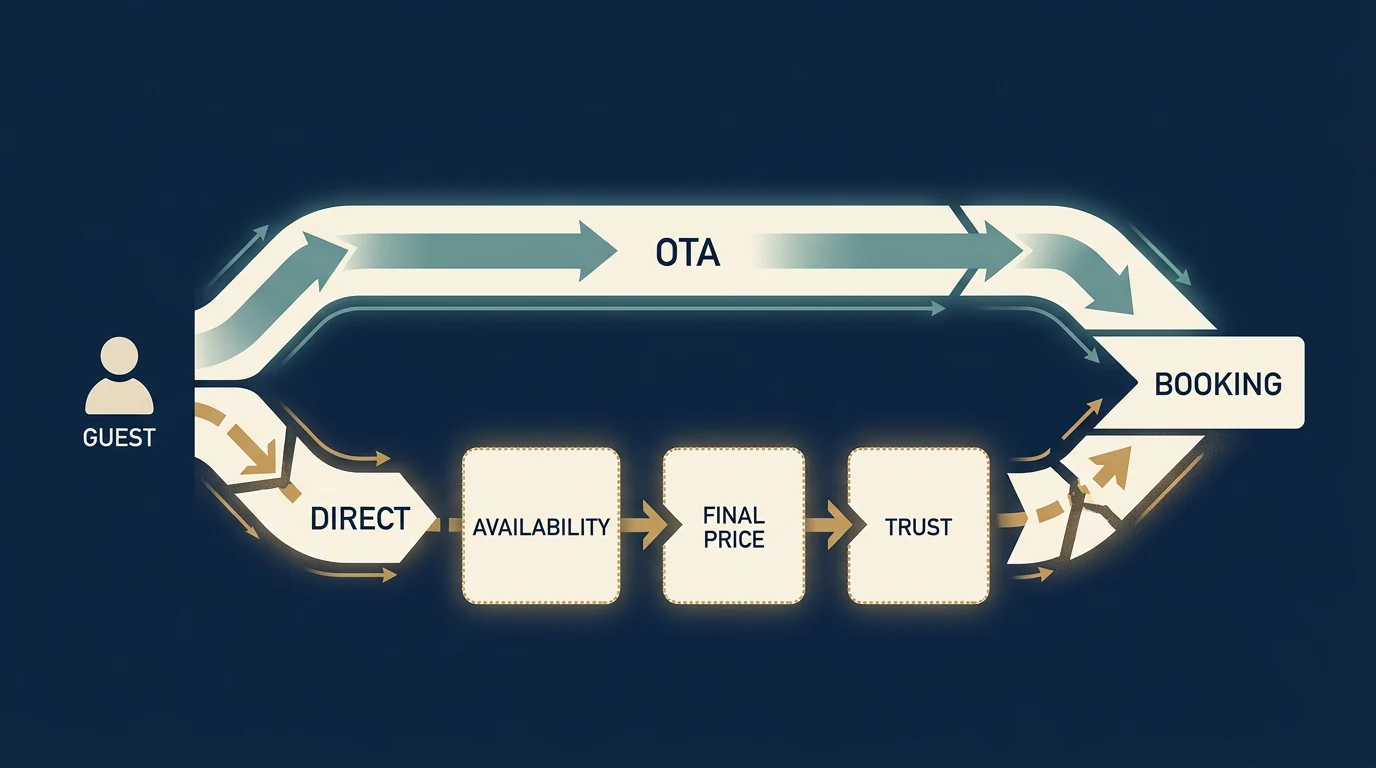
What the OTA is actually selling
The OTA sells comparison and convenience. It reduces the guest’s risk: is the room available, what is the final price, what do other guests say, and what happens if plans change? The OTA answers those questions in a familiar interface.
Your hotel page has to do the same work with its own proof. A gallery, a phone number and a “book now” button are not enough if the guest still has to ask whether the room is available.
Why this matters to the owner
Every OTA booking carries a commission and weakens the direct relationship. The guest may never see the hotel’s own site, never join the list and never return direct. The hotel is renting demand instead of building it.
The first step is not to remove the OTA. It is to find the field that sends the guest back to the OTA after they have already found the hotel.
When to act
- When OTA share rises while occupancy is stable.
- When direct bookings fall after a season or a rate change.
- Before the next peak season, not during it.
- After a renovation, a rebrand or a room-category change.
- When the front desk is answering the same availability question repeatedly.
At a glance: where the booking path leaks
| Stage | What the guest asks | What the OTA shows | What the hotel page often misses |
|---|---|---|---|
| Discovery | Is this hotel relevant? | Map, rating, price | Room-level proof and location context |
| Comparison | Is it available and what is the final price? | Dates, price, cancellation | Live availability and final cost |
| Trust | What did recent guests say? | Recent reviews | Room-specific review evidence |
| Action | How do I confirm? | Instant booking | Response time and fallback contact |
Decision table: what to fix first
| If you are… | First check | Common mistake | First action |
|---|---|---|---|
| OTA-dependent | Direct path vs OTA path on five fields | Discounting before fixing the page | Fix availability and final price |
| Direct-first | Whether direct is actually easier | Assuming the guest trusts the brand | Add recent proof and response time |
| Group bookings | Group terms and hold policy | Using the retail booking form | Add a group-specific path |
| A new hotel | First reviews and room-level photos | Spending on ads before proof | Complete the listing and ask for reviews |
| A seasonal hotel | Peak-season availability and cut-off | Showing an off-season rate | Show the seasonal terms clearly |
What the hotel page must answer
The booking page does not need to copy the OTA. It needs to answer the fields that send the guest back to the OTA:
- Is a room available for my dates? Show a live or clearly timed availability path.
- What is the final price? State taxes, occupancy and cancellation before the form.
- Where is the hotel, really? Use landmarks and travel time, not only a map pin.
- What do recent guests say? Link the review evidence to the room type.
- Who confirms the booking? Give a response window and a fallback contact.
- What happens if plans change? Put the cancellation and modification terms in plain language.
If the page cannot answer one of these, the guest is not being difficult. They are doing what the OTA trained them to do.
How to run the first check
- Pick one hotel and one future date.
- Open the OTA listing and the hotel’s own booking page.
- Compare five fields: final price, availability, cancellation, recent reviews and contact/confirmation.
- Mark which field the hotel page cannot answer.
- Fix the first missing field before changing the design.
That is a five-field comparison, not a revenue forecast. It shows where the booking path leaks.
Who does what
| Task | Owner | What good looks like |
|---|---|---|
| Availability and cut-off | Front desk | Current dates and a clear response window |
| Final price and cancellation | Owner/GM | Plain-language terms before the form |
| Room-level proof | Marketing | Current photos and recent review evidence |
| Direct booking path | Web/SEO | One path, one confirmation, one fallback |
| Monthly OTA comparison | Marketing | Same hotel, same date, five fields, dated |
The catch
Booking data is private. We cannot see how many people compared a hotel and chose an OTA. We can only inspect the public path: what the listing shows, what the hotel page shows, and which fields are missing.
A direct-booking discount is not a strategy by itself. If the page still lacks availability, cancellation terms or trust evidence, the discount may attract price shoppers without fixing the comparison gap.
FAQ for hotel owners
Why do guests use OTAs if the hotel has a website?
Because the OTA answers comparison and availability faster. Convenience is part of the product.
Should the hotel remove OTA listings?
Not automatically. The OTA can create demand. The question is whether the hotel page can convert the guest who wants to book direct.
Does a direct-booking discount fix the leak?
Only if the rest of the path is clear. A discount cannot answer availability, cancellation or trust.
Can this page tell me my booking rate?
No. It shows the public comparison fields. Booking data stays private.
What should be fixed first?
The field that blocks the decision: usually live availability or the final price.
Related
- Dehradun hotel market hub
- Best hotels in Dehradun: what the list means for an owner
- Dehradun hotel price: what price searches tell an owner
- Run a local market audit
Demand figures are third-party estimates. Booking data is not public. No booking, occupancy or revenue guarantee is made.