
Direct answer: “Dehradun hotel price” is not a request for the cheapest room. It is a comparison query. The guest is trying to understand what a room should cost and what the price includes. If your page answers only the number, the guest returns to the OTA or the hotel that explains the comparison better.
Who this is for
This is for the owner or manager of an independent hotel, a small chain or a boutique property in Dehradun. It is not a traveller’s booking guide. The question is commercial: how should the hotel present price so the right guest can compare it without defaulting to a booking platform?
What price searches actually mean
A price query is a comparison query. The guest is not just asking “how much?” They are asking:
- What does the price include?
- Is this room available for my dates?
- Is the location worth the price?
- Do recent guests think it is worth it?
- What happens if my plans change?
Google’s hotel pack can show price, rating and a booking link in the same block. The guest can compare the basics without opening every hotel website. That is why a bare price page loses.
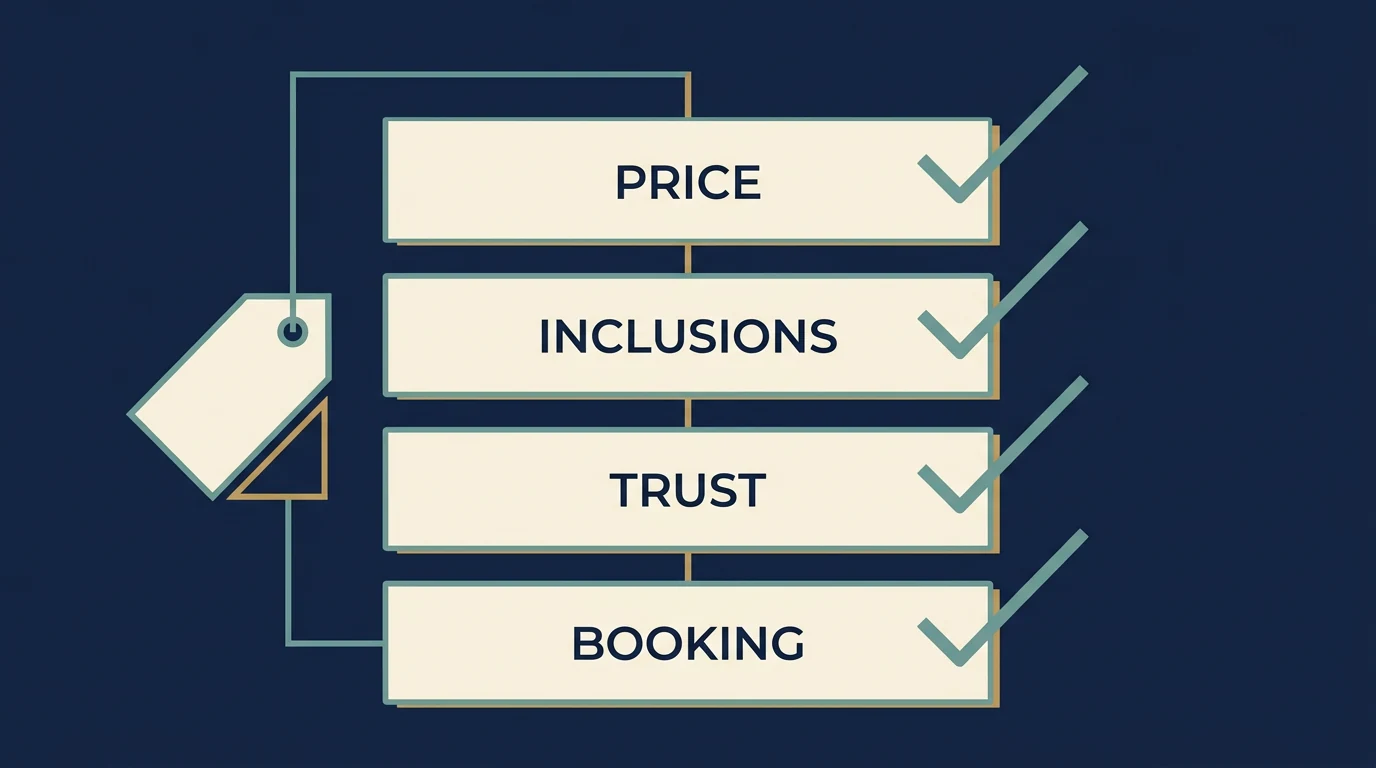
Why discounting first is a mistake
A discount is easy to copy. It also trains the guest to compare only on price. If the page still lacks availability, cancellation terms or recent proof, the discount may attract price shoppers without fixing the comparison gap.
The better first question is: what is missing from the page that makes the guest open another tab? Fix that before cutting the rate.
When to review the price page
- Before the next season, not after the bookings fall.
- After a room renovation or a category change.
- After an OTA commission change.
- When direct bookings fall but occupancy is stable.
- When the hotel is attracting low-value enquiries.
At a glance: where the guest compares
| Surface | What the guest compares | What the owner controls | What it does not prove |
|---|---|---|---|
| Hotel pack | Price, rating, location | Profile, reviews, rate, website | That the room fits the trip |
| OTA | Price, availability, cancellation | Listing content, rate, response | That the guest will book direct |
| Own site | Room detail, story, direct price | Page, availability, trust, contact | That the guest will find it |
| Phone / WhatsApp | Human reassurance | Response time, hold policy | That the enquiry is recorded |
Decision table: what to fix first
| If you are… | First check | Common mistake | First action |
|---|---|---|---|
| A budget hotel | Final price and room type | Showing a base rate that excludes taxes | Show the final comparison fields |
| A midscale hotel | What the price includes | Competing only on the number | Add breakfast, cancellation and location proof |
| A boutique hotel | Room-level story and reviews | Using generic property photos | Show the room the guest is buying |
| A chain property | Brand rate vs direct rate | Assuming the brand page is enough | Fix the local page and direct path |
| An OTA-dependent hotel | Direct-booking reason | Discounting without proof | Fix availability, cancellation and trust |
What the price page must show
A price page is a comparison page. It should answer the fields a guest checks before returning to the booking platform:
- Room type: what the price actually buys, including occupancy and bed setup.
- Date and season: whether the price is a sample, a range or a live rate.
- Final cost: taxes, extra-bed charges and cancellation terms.
- Location proof: distance to the station, airport road or the area named in the search.
- Recent review evidence: what guests said about the room, not only the property.
- Direct next step: a clear way to confirm availability without a form that may not be answered.
If any of those fields is missing, the guest has to open another tab. The cheapest page is not necessarily the one that wins; the clearest page often does.
How to run the first check
- Search “dehradun hotel price” in Google.
- Record the first ten hotel-pack or organic listings.
- For each, note price, review count, area, cancellation terms and whether a direct booking link is visible.
- Compare the cheapest listing with the most-reviewed listing.
- Write down which field is missing from your own page.
That is a comparison audit, not a pricing strategy. It shows where the page is losing the explanation, not what to charge.
Who does what
| Task | Owner | What good looks like |
|---|---|---|
| Rate and inclusion accuracy | Owner/GM | Every room type has a current price logic |
| Cancellation terms | Front desk | Plain-language terms beside the price |
| Room-level photos | Marketing | Current photos of the room being sold |
| Direct booking path | Web/SEO | Availability, final price and contact |
| Monthly price check | Marketing | Same ten listings, same day, dated record |
The catch
Listed prices change by date, room type, occupancy and cancellation policy. A price snapshot is not a rate card. It cannot tell you what a hotel will charge next month, and it cannot prove that a lower price will win more bookings.
Review counts also do not explain distribution. A hotel can have a strong review score and still be invisible in the hotel pack. Keep the price question and the visibility question separate.
FAQ for hotel owners
Should a hotel compete on the lowest price?
Only if the rest of the page can support it. A low price with weak proof is easy to ignore.
Does the hotel pack show the final price?
It shows a price for the selected dates, but taxes, occupancy and cancellation terms can still change the final amount.
Do more reviews raise the price a hotel can charge?
Reviews can support trust, but they do not set a price. Demand, seasonality, room type and competition also matter.
What should I fix first?
The field that blocks the comparison: usually the final price, availability or cancellation terms.
Can this page predict occupancy?
No. It explains the comparison. It does not forecast bookings or revenue.
Related
- Dehradun hotel market hub
- Best hotels in Dehradun: what the list means for an owner
- Hotel booking in Dehradun: OTA or direct
- Run a local market audit
Demand figures are third-party estimates. Prices and availability change. No booking, occupancy or revenue guarantee is made.