
Choosing ecommerce or a service website is not mainly a technology decision. It is a decision about what the customer is buying, how the business delivers it, what must be measured and how much operational complexity the founder can carry.
An ecommerce business sells a product through a repeatable product, checkout and fulfilment path. A service business sells expertise, access, a defined outcome or ongoing work through an enquiry, consultation, booking or proposal path. Both can use SEO, Google Ads, Meta Ads, email and content. The customer journey is not the same.
Direct answer
Choose ecommerce when the offer can be described, priced, delivered and supported through a repeatable catalogue or checkout journey. Choose a service website when the buyer needs trust, diagnosis, qualification, custom scope or a conversation before a price can be confirmed.
Some businesses need both. A product company may offer installation or consulting. A service company may sell a fixed audit, course or digital product. The right architecture gives each journey its own page, proof and next action.
Compare the customer journey first
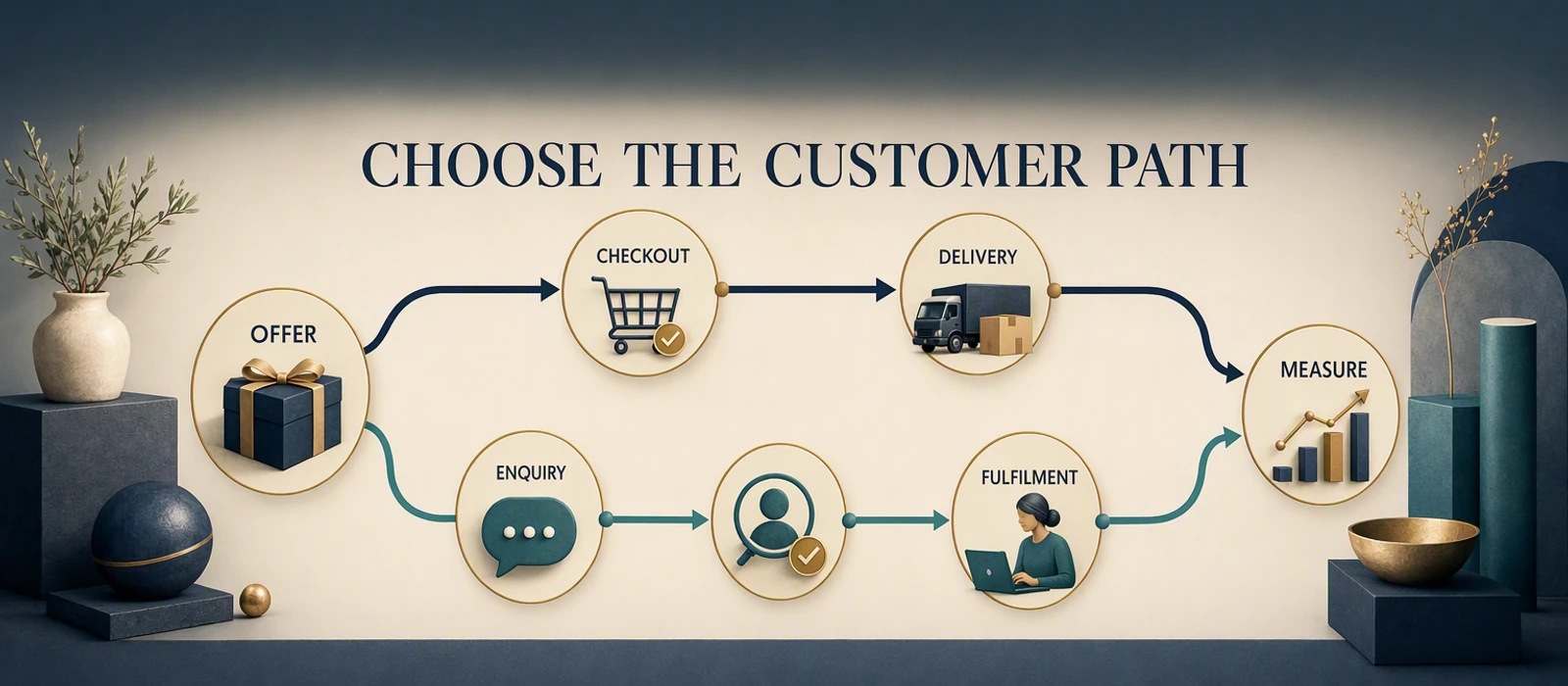
| Decision point | Ecommerce | Service website |
|---|---|---|
| Main page type | Product and collection pages | Service and problem pages |
| First conversion | Add to cart, checkout or subscription | Form, call, booking or proposal |
| Trust question | Is the product real, suitable and deliverable? | Can this provider understand and solve my problem? |
| Main friction | Price, shipping, returns, stock and checkout | Scope, proof, fit, access and decision risk |
| Useful measurement | Conversion rate, AOV, margin, repeat purchase and refunds | Qualified enquiries, booked calls, quotes, close rate and delivery fit |
| Search architecture | Product, category, comparison and buying guides | Service, problem, audience and evidence pages |
The table is a starting point, not a rule. A business should record the actual journey it expects a customer to take before choosing its platform or campaign.
Start with the offer, not the platform
Ask five questions:
- What exactly is the customer buying?
- Can the customer understand the offer without a live explanation?
- Can price, delivery, availability and support be stated accurately?
- What happens after payment or enquiry?
- Which event tells the business that the customer became qualified or bought?
If these answers are unclear, changing from one ecommerce platform to another will not solve the business-model problem. Start with a narrow offer and a testable customer path.
What ecommerce needs before launch
An ecommerce foundation includes more than a theme and a payment button:
- a product and collection structure that matches how customers search;
- accurate descriptions, specifications, images and availability;
- payment, shipping, tax, returns and support information;
- a clear mobile checkout path;
- analytics and conversion events that can be checked;
- a plan for product-page SEO, category SEO and internal links;
- an operating process for inventory, fulfilment and customer questions.
The Shopify Online Store Setup guide and Shopify versus WooCommerce comparison cover platform-specific decisions. Do not make a platform comparison carry the whole business-model decision.
What a service website needs before promotion
A service site needs a different foundation:
- a clear service definition and audience;
- a page for the actual problem or decision;
- evidence that is genuine and permitted to be shared;
- a scope, process or first-step explanation;
- a contact path that records the right event;
- qualification questions that protect both sides from a poor fit;
- a follow-up process for enquiries, proposals and delivery.
A service website does not become credible merely because it has more pages. One well-owned service page with a clear next action is more useful than several thin pages that repeat a general promise.
How acquisition changes by model
Ecommerce can use category and product intent, shopping discovery, buying guides, remarketing and lifecycle email. A service business may need problem-led search, expertise pages, local or industry context, case-study boundaries and a conversation path.
The Ecommerce Marketing Channels guide will map SEO, paid search, Meta, email and measurement without treating every channel as interchangeable.
Before buying traffic, use the SEO audit guide to check whether the page, intent and technical foundation agree. An audit is a diagnosis, not a promise that traffic or sales will follow.
A practical decision sequence
Customer problem
      ↓
Offer and delivery model
      ↓
Ecommerce checkout or service enquiry path
      ↓
Page ownership and measurement
      ↓
Organic and paid acquisition
      ↓
Support, fulfilment and repeat decision
Complete each layer before adding the next. If the checkout or enquiry path is not measurable, more traffic only makes the uncertainty larger.
A worked founder decision
Imagine a founder choosing between selling a small physical product range and selling a specialised implementation service. The product idea may look easier to explain because the price can appear on a product page. That does not make it operationally simple. The founder still needs stock, delivery, returns, support, product information, payment handling and a way to understand whether a sale is profitable after fulfilment costs.
The service idea may have fewer transactions but more qualification work. The buyer may need a conversation before scope and price can be confirmed. The site therefore needs a clear problem page, proof that can be shared, a qualification path and a follow-up process. A service model is not automatically lower effort; it moves effort from fulfilment and inventory into trust, diagnosis and delivery.
Use this sequence before choosing a platform:
- Write the offer in one sentence without naming the technology.
- Describe the first customer action: checkout, booking, enquiry or proposal.
- List the work that happens after that action.
- Identify the cost, delay or risk that could stop delivery.
- Choose the page and measurement event that represent the real decision.
If the offer cannot be described clearly, a website redesign will not resolve the underlying uncertainty. The first useful asset may be a narrow landing page, product test or enquiry script rather than a complete store.
A 30-day validation sequence
The first month should test the customer path, not attempt to prove the whole business model. In week one, define the audience, offer, price or qualification boundary and the event that counts as a useful response. In week two, publish or prepare one focused product, collection, service or problem page. Make delivery, returns, scope, support and the next action visible.
In week three, observe real questions and friction. Record where people hesitate, what information they ask for and whether the proposed event can be measured. In week four, review the evidence and choose one change: clarify the offer, remove a delivery constraint, improve the page, change the qualification step or pause the model. Do not interpret a small number of visits or enquiries as proof of profitability.
This sequence is deliberately the same for both models. What changes is the customer path and the operating work behind the conversion. The decision is not “Which website type ranks better?” It is “Which operating model can deliver a clear customer promise and produce evidence that the next decision is sensible?”
Limits
The choice between ecommerce and a service website does not predict profitability, ranking, traffic, leads or sales. Demand, competition, pricing, delivery, creative quality, tracking and customer experience all affect the result.
Checklist
- [ ] Define the customer and offer in plain language.
- [ ] Choose checkout, enquiry or a deliberate combination.
- [ ] Assign product, service and comparison page owners.
- [ ] Make payment, delivery, scope and support clear.
- [ ] Test the first conversion event before promotion.
- [ ] Start with one acquisition question and one review date.
Next step: validate the path
If the first search or page constraint is unclear, start with a bounded SEO audit before choosing more tools or traffic.
Sources and limits
This article uses dated consumer-facing evidence and clearly labelled teaching examples. Examples are directional, not forecasts or guarantees. No private client information, credentials or internal implementation details are included.
Related
- Ecommerce SEO Guides: Architecture, Analytics and Channels
- Ecommerce Analytics: What to Measure Before You Scale
- Ecommerce Marketing Channels: SEO, Google Ads, Meta Ads and Email
Dated guidance. No ranking, traffic or revenue guarantee.
Choose the next step
Compare the fixed-scope options or book a fit call.
See which pages lose clicks
Run the free website SEO audit to find the pages Google already shows but that earn almost no clicks, then fix the highest-impact issues first.