
Direct answer: a sales funnel audit finds where a site earns attention but loses the next step. We look at the path from the first visit to the enquiry, identify the first leak, rank the fix order and measure the change. The full scoring model, stage map and audit sequence are scoped work, not published here.
This is not a traffic report. A page can rank, earn a click and still lose the buyer because the next step is missing, unclear or in the wrong place.
What you get
- One ranked fix order. The pages and paths that are losing the buyer, ordered by what to fix first.
- One clear next step. The action that belongs on the page, not the same sitewide CTA on every page.
- Dated evidence. The page, query, observed problem and the change, with the limits attached.
- A measurement window. What will be checked after the change, and when.
Watch the 45-second explanation
Dated self-audit summary. No ranking or revenue guarantee.
What the public sample shows
We ran the diagnosis on our own site. The sample is dated and public; it is not a client story. The full sample and its limits are on the SEO audit report page.
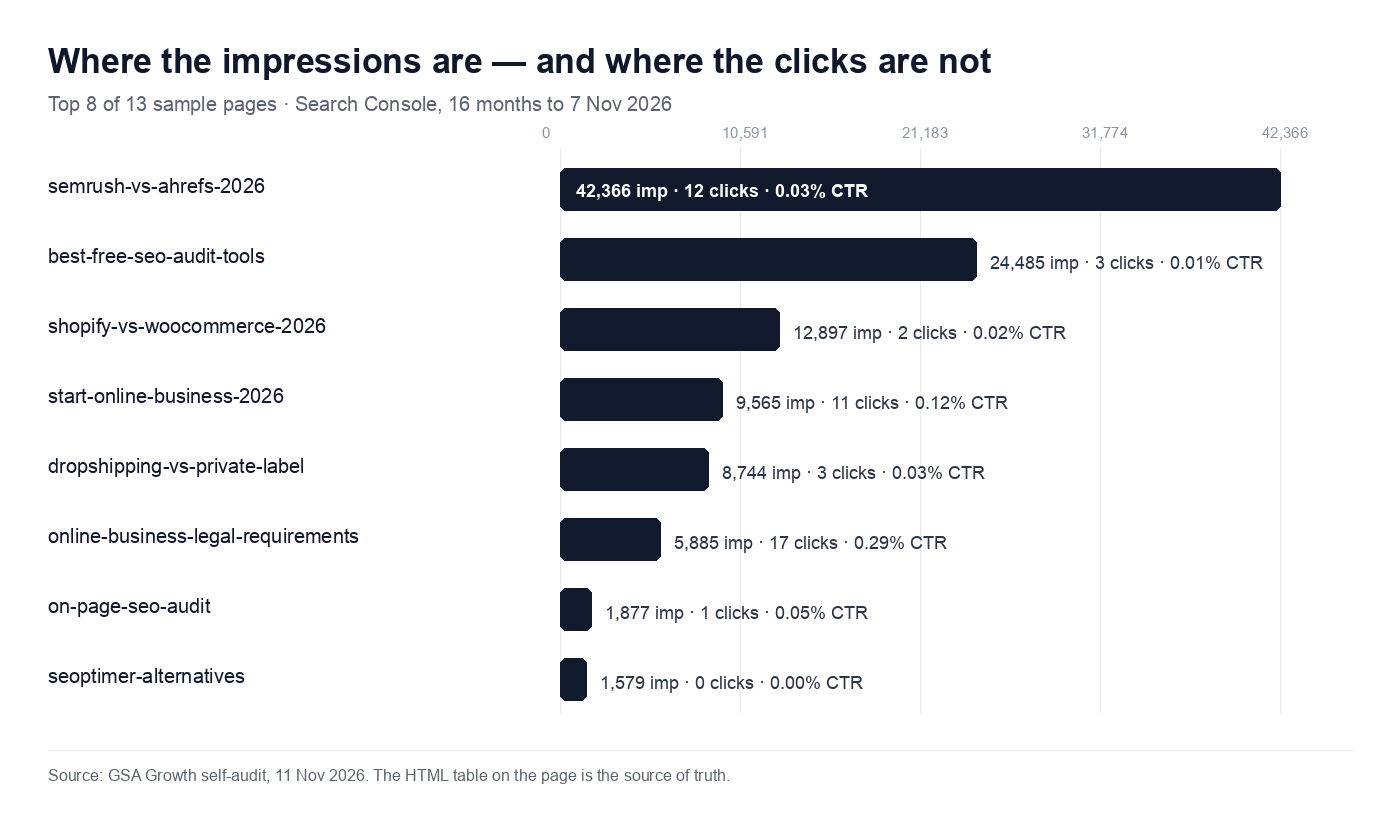
The first public sample showed three things:
- A 305-page site can still have a large share of pages with no declared next step.
- One sitewide CTA is not a funnel. It asks every reader for the same offer, regardless of where they are in the decision.
- A money page can have hundreds of inbound links and still very few impressions. A near-sitewide link is not a contextual recommendation.
The funnel score for that sample was 78/100. The judgement was simple: the first fix is not more traffic. It is one relevant next step on the pages that already have demand, plus a contextual route to the offer and the proof.
What we expect — registered 12 November 2026
This is a public self-audit, not a completed client case study. We are recording the expectation before the result.
Logic: a clear next step should reduce dead ends. A relevant next step should send more contextual visits to the offer pages. More contextual offer visits should make assisted conversions easier to measure. AI citations are a separate, slower surface and may not move on the same timeline.
| Expectation | Metric | Check date | Status |
|---|---|---|---|
| Clearer next steps reduce dead ends. | 312/312 pages with a declared next step; 0 non-other pages missing a primary CTA; 0 CTAs that link a page to itself. | 26 Nov 2026 | Pending |
| Relevant next steps earn contextual visits to offer pages. | Offer-page impressions and clicks against an unchanged control set. | 26 Dec 2026 | Pending |
| More contextual offer visits make assisted conversions measurable. | At least one assisted-conversion path or qualified-enquiry event. | 26 Feb 2027 | Pending |
| AI citations may lag search and conversion changes. | The same 15-prompt panel: grounded citations and search-index returns, reported separately. | 26 Feb 2027 | Pending |
What would tell us we were wrong: no measurable offer-page change after 60 days; no next-step CTA clicks after 30 days; no AI citation change after 90 days; or the unchanged control pages move by the same amount, which would point to seasonality rather than the change.
Control set: locked 12 November 2026 — 10 comparable content pages (five discovery, five comparison) are left without the stage CTA. Download the control-set CSV. If the control and treatment pages move together, the log will say the change is inconclusive.
Baseline lock: the baseline is dated and hashed. It will not be edited retroactively.
- Download the baseline CSV — SHA-256
66f9563e88f596d5a9695a575bd2249d2e108afd67a2c9dba833f0c875d7c0b1 - Download the registered expectations CSV — SHA-256
f89e90b48491a0be07ae2bbbb9f51682998cfedab692494a7cb5a2db6b58a4db
What this does not prove
This is a self-audit, not a controlled experiment. It does not measure revenue per click or per lead. It does not prove that a new CTA will increase revenue. It does not treat a page-one position as demand you own, or a 301 as a fix by itself.
The public sample shows the diagnosis and the decision. It does not publish the full method, the scoring rubric or the client data.
How it fits the Revenue-Leak Audit
The funnel diagnosis is one layer of the Revenue-Leak Audit:
- X-Ray — $199: the page and query list, with three prioritized rewrite briefs.
- Blueprint — $499: five rewrite briefs, the entity gap and the full funnel gap list.
- Command — $899: ten rewrite briefs, a fifteen-question AI visibility check, the funnel score and a ninety-day re-audit.
The SEO audit services page explains the fixed scope. If the bottleneck is one page rather than the whole path, Content Refresh is the narrower unit. If you want to see how the evidence is presented before choosing, read a case study or the dated sample.
What stays private
The public page explains the problem and the deliverable. The following stay in scoped work:
- the stage map and how pages are assigned;
- the scoring model and thresholds;
- the prioritisation logic;
- the CTA and path rules;
- the data joins and the audit sequence;
- client data and client-specific findings.
That is deliberate. You are buying the diagnosis, not a public copy of the method.
FAQ
What is a sales funnel audit?
It is a review of the path from a search visit to the offer. It finds where attention is lost, what to fix first and what should happen next. It is not a traffic report or a ranking guarantee.
What do I get?
A ranked fix order, one clear next step for the priority pages, the evidence behind each finding and a measurement window.
Does it include AI visibility?
The Command tier includes an AI visibility check. The funnel diagnosis itself does not claim that an AI system will cite the page; it checks whether the page gives a reader and a retrieval system a clear next step.
What stays private?
The stage map, scoring model, thresholds, prioritisation logic, CTA rules, data joins and client findings are scoped work. The public sample shows the diagnosis and the decision, not the full method.
Is it a guarantee?
No. This is a diagnosis and a measurement plan, not a promise of rankings, traffic, citations or revenue.
Reviewed by Arvind Jadli, 12 November 2026. AI-assisted, human-reviewed. The evidence, scope and recommendations are mine. This page is a consumer-facing summary, not the full audit rubric.
Dated guidance. No ranking, traffic or revenue guarantee.
Choose the next step
Compare the fixed-scope options or book a fit call.
See which pages lose clicks
Run the free website SEO audit to find the pages Google already shows but that earn almost no clicks, then fix the highest-impact issues first.