
Direct answer: A report that shows clicks without page ownership is a monthly ritual. A decision system shows which page changed, which query moved, what was done and what happens next. The difference is not the tool. It is the question the report is built to answer.
Who this is for
This is for an Indian business owner, marketing manager or agency lead who receives a monthly SEO report and still has to ask “so what should we do?” It is not a template dump. It is a test for whether the report earns its place.
Why the monthly report often fails
Most reports are built from what the tool exports, not from the decision the team needs. They show totals, averages and a long keyword table. The reader cannot tell which page is winning, which page is losing or which action was taken last month.
A report becomes useful when it connects four things: page, query, action and next check.
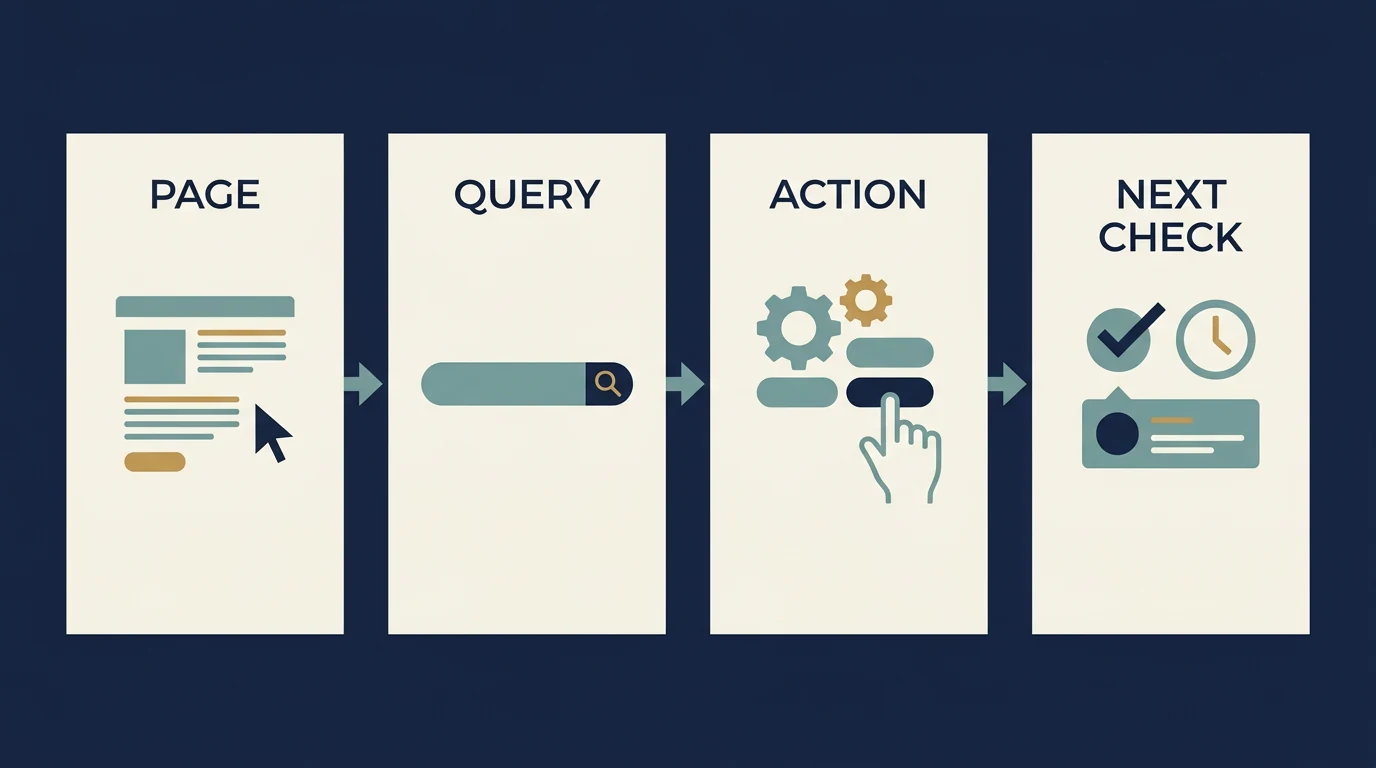
At a glance: three report layers
| Layer | Question | What it proves | What it does not prove |
|---|---|---|---|
| Visibility | Is the page seen? | Impressions and query presence | That the page is chosen |
| Selection | Is it chosen? | CTR and snippet response | That the click became an enquiry |
| Outcome | Did the next step happen? | Calls, forms or qualified leads | That SEO caused the outcome |
Decision table: what to do with each report line
| Report line | Keep it if… | Remove it if… | Next action |
|---|---|---|---|
| Total clicks | It is tied to a page decision | It is only a mood indicator | Break it by page |
| Average position | It explains a query change | It hides query mix | Show the query group |
| Keyword count | It maps to owned pages | It is a vanity total | Show ownership |
| Traffic value | It is labelled as an estimate | It is presented as revenue | Remove or relabel |
| Action log | It names page, date and owner | It is a list of activities | Add the next check |
What a useful Indian SEO report includes
- Page: the URL that changed or needs a decision.
- Query: the search wording and intent.
- Window: the date range, device and location.
- Action: what was done, or what is proposed.
- Evidence: the observed signal and its limitation.
- Next check: the date and metric for review.
How to test the report
- Remove one metric from the report.
- Ask whether the decision changes.
- If it does not, the metric may be decoration.
- Repeat until only decision-bearing lines remain.
Who does what
| Task | Owner | Output |
|---|---|---|
| Choose the decision | Business owner | One question for the month |
| Pull the evidence | SEO lead | Page, query, window |
| Write the action | Content/web | One change and one owner |
| Review | Business owner + SEO | Keep, change or stop |
A simple report skeleton
One page can hold the whole decision:
- Decision: the one question this month.
- Page: the URL that changed or needs a decision.
- Query: the search wording and intent.
- Evidence: impressions, clicks, CTR and position for the same window.
- Action: what was done and who owns the next step.
- Limit: what the data cannot prove.
- Next check: the date and comparison.
If a line does not fit that skeleton, it may belong in an appendix, not the decision page.
Common mistakes
- Reporting totals without pages. The reader cannot act.
- Showing traffic value as revenue. It is an estimate.
- Changing the window every month. The comparison becomes noise.
- Listing activities as outcomes. “Published 4 posts” is not a result.
The catch
Attribution is imperfect. A lead may see an ad, read a page, search the brand and enquire later. A monthly report cannot prove that one page caused one sale. It can show whether the page is seen, chosen and connected to a next step.
Small data is also a limit. An Indian business with a narrow locality or a new site may not have enough rows for a confident conclusion. The report should say so.
Free check
Open last month’s report and highlight every line that names a page and an action. If less than half the lines survive, the report is not yet a decision system.
FAQ
How long should an SEO report be?
As short as the decision allows. One page can be enough if it names the page, query, action and next check.
Should we report rankings?
Only with the query, page, location and date. A rank without scope is not useful.
Should we report traffic value?
Only as a labelled estimate. It is not revenue.
How often should we report?
Match the cadence to the decision: weekly for a live campaign, monthly for content, quarterly for strategy.
Is this a ranking guarantee?
No. It is a reporting and decision method.
Related
Reports are dated observations. Attribution is imperfect. No ranking, traffic or revenue guarantee is made.