
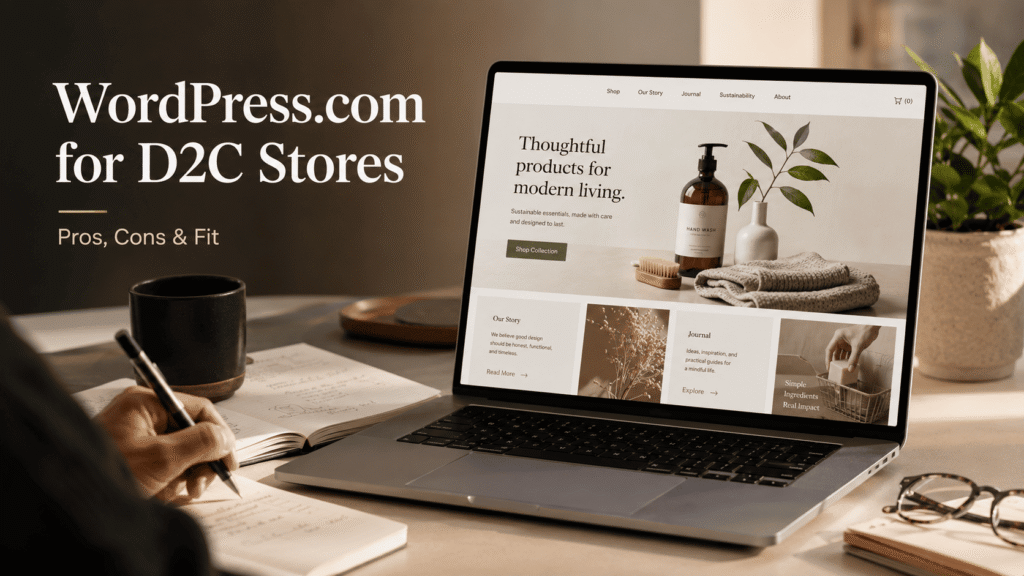
Updated September 2026: Verify current plans, pricing, features, and recommendations against official sources before acting.
WordPress.com for D2C: WordPress.Com D2c: Intro
A D2C brand usually does not just need “a website.”
It usually needs two things at the same time:
- a place to sell
- a place to explain, position, educate, and build trust
That distinction matters more than people think.
Because when someone asks whether WordPress.com works for a D2C brand, the real answer depends on which of those jobs they are actually trying to solve.
If the goal is fast publishing, low-maintenance brand building, landing pages, and content-led trust, WordPress.com can make sense.
If the goal is deep ecommerce flexibility, heavier store customization, and a more operationally complex commerce setup, the answer gets more complicated very quickly.
That distinction matters because many D2C founders are not really choosing between “website A” and “website B.” They are choosing which layer of the business they are trying to strengthen first. If the immediate need is better storytelling, cleaner publishing, stronger trust, and more consistent brand communication, WordPress.com can be a sensible tool. If the immediate need is heavier operational control over catalog, checkout, apps, or store logic, the evaluation changes.
That is the lens I’d use here.
The strongest case for WordPress.com in D2C
The strongest case for WordPress.com is not that it is the universal best platform for ecommerce.
It’s that it can give a D2C brand a cleaner, lower-maintenance way to publish, tell its story, and build authority without turning that process into a technical side project.
That matters more than it sounds.
A lot of founder-led brands do not just need a storefront. They also need:
- product storytelling
- brand pages
- trust-building content
- landing pages
- educational articles
- a publishing workflow they will actually keep using
This is where WordPress.com starts to look more useful.
A lot of D2C teams underestimate how much commercial value sits outside the transaction itself. Product education, trust pages, founder story, category explanation, and search-led content all influence conversion even when the actual purchase happens elsewhere. That is why the “content layer” argument is not a soft branding point. For many brands, it is a real growth lever.
Where it fits best
I think WordPress.com fits best for D2C brands that are:
- founder-led
- relatively lean
- content-aware
- trying to build trust and brand presence without adding too much technical overhead
If the team is small and the real need is a reliable publishing and brand layer, the managed nature of WordPress.com can be a genuine advantage.
You spend less time thinking about infrastructure and more time thinking about what the brand is saying.
That is often a better trade for a young or lean team than many people admit.
Why the content layer matters so much
A lot of D2C growth does not come from the transaction page alone.
It comes from the layer around the transaction:
- why the product exists
- what problem it solves
- why a buyer should trust the brand
- how the brand explains its category
- how it captures search demand over time
That is why I think the most honest framing here is this:
For many D2C brands, WordPress.com makes the most sense when you treat it as a low-maintenance publishing and brand-building layer. The more you expect it to behave like a fully flexible commerce stack, the more its limits start to matter.
That is not a weak answer.
It is actually the useful answer.
Where it starts to feel limiting
This is where the article has to stay honest.
WordPress.com is not automatically the right answer for a D2C brand just because it is easier to manage.
Once the store side becomes more complex, the limitations matter more.
That includes situations where the business needs:
- deeper ecommerce customization
- more operational flexibility
- a stronger commerce-native stack
- workflows built around heavier store complexity rather than cleaner publishing
This is the line many generic reviews blur.
Content and commerce are not the same operational need.
A platform can be very good for one and only partially suited for the other.
The most honest use-case framing
If I were explaining this to a D2C founder in one sentence, I would say this:
WordPress.com is often more compelling as a content and brand layer around commerce than as the default answer for complex store operations.
That is not a dismissal.
It is a clarification.
And for the right kind of brand, that clarification is already enough to make the platform worth considering.
Which D2C brands should consider it
I think WordPress.com is worth considering for:
- early-stage brands
- founder-led brands
- brands using content to build trust
- simpler catalogs
- teams that want lower maintenance
- businesses that care about publishing consistency but do not want to manage a heavier technical stack
If the question is, “Can this help us build a cleaner brand presence and publish more consistently without extra operational drag?” then WordPress.com becomes much more interesting.
Which D2C brands should probably avoid it
I would be more cautious if the brand is:
- running a more complex store operation
- highly dependent on deep customization
- expecting the platform to behave like a fully flexible commerce engine
- likely to outgrow a managed structure quickly
That does not mean the platform is bad.
It means the role has to match the need.
And for some D2C brands, the wrong role creates frustration fast.
Honest limitation section
WordPress.com is not the universal best platform for ecommerce.
That has to be said plainly.
Its value for D2C is strongest when the business needs a lower-maintenance publishing and brand layer.
The further the business moves toward complex store operations and deeper commerce customization, the more likely it is that the platform will start to feel bounded.
That is usually the turning point: the platform stops being evaluated as a publishing system and starts being judged as a commerce operating environment. Those are not the same test. A setup that feels efficient for content, trust, and brand storytelling can still feel too constrained for a more demanding store operation.
So yes, some D2C brands will outgrow it quickly.
That does not make it a bad choice.
It just means it is not the right choice for every version of ecommerce.
Final verdict
If you run a lean, content-aware D2C brand and want a cleaner, lower-maintenance way to publish and build trust, WordPress.com is worth a serious look.
If your real need is deep ecommerce flexibility and broader operational control, I would be careful about forcing the wrong tool into the wrong job.
That is the real answer.
WordPress.com can genuinely help a D2C brand.
It is just not the right tool for every D2C brand.
If you want to explore WordPress.com for yourself, you can check it out here: WordPress.com
If your D2C brand mainly needs a cleaner, lower-maintenance way to publish and build trust, WordPress.com is worth considering. If your real need is deep store flexibility, be careful not to force the wrong tool into the wrong role.
Author bio: Arvind Jadli is a seasoned content operator and digital strategist specializing in publishing infrastructure and editorial workflows. With years of experience scaling content properties, he breaks down complex CMS platforms to help teams build faster, manage smarter, and publish better.
Frequently Asked Questions
Recommended Reading
Handpicked by Arvind – books that actually changed how I think about this topic.
SEO 2026: Learn Search Engine Optimization with Smart Internet Marketing Strategies
Best Hosting to Start an Online Business 2026
Tested by GSA. Best price-performance for Indian D2C stores. (Affiliate links – we earn a small commission at no extra cost to you.)
Sources & further reading: Search Engine Land
Further reading: Statista · Search Engine Land
Affiliate disclosure: This article may contain sponsored affiliate links. If you purchase through one, GSA may earn a commission at no additional cost to you. Recommendations are based on fit, operational trade-offs, and publicly available evidence, not commission rates.
See which pages lose clicks
Run the free website SEO audit to find the pages Google already shows but that earn almost no clicks, then fix the highest-impact issues first.