
Updated September 2026
Practical Online Business Guide 2026: Step-by-Step to Success
If you are looking to start online business in India while keeping your day job, this article is for you.
A plan without a deadline is a wish.
Paid ads without organic traction is money on fire — build at least one organic channel to breakeven CAC before scaling any paid spend, because the day the ads stop the business should not stop with them.
You are 35. You are an achiever. You have a designation that commands respect, a salary that covers the EMIs, and a family that relies on you. By every metric of traditional Indian society, you have “made it.”
But deep down, you have hit the “Mid-Career Stall.”
The promotions are slower. The increments are predictable—barely beating inflation. The work, while comfortable, has stopped feeling like a calling and started feeling like a transaction. You have a nagging, persistent ambition to build an asset—something that is truly yours—but you are paralyzed by the risk.
You cannot afford to be a reckless 20-year-old “hustler” who can sleep on a floor and eat Maggi for two years. You have school fees. You have parents to care for. You have a reputation. You have too much to lose.
So, you scroll. You read success stories on LinkedIn. You attend webinars promising crores in 90 days. And you feel that hollow disappointment every time—because those plans are not built for you. They are built for people with nothing to lose. They are not built for someone with your experience, your responsibilities, and your deep-seated need for meaningful, dignified work.
Stand down.
This ends now.
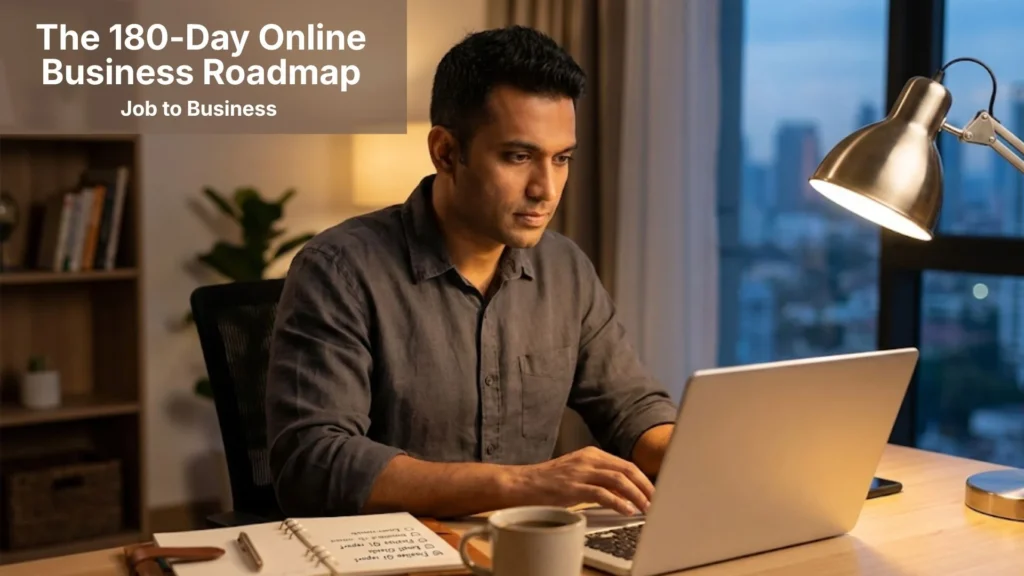
What you hold is not another “side hustle” blog post. It is a structured command doctrine. A practical, 180-Day Command Framework to transition from a stable professional to the founder of a legitimate, asset-grade online business.
This is the HUB—the master operational plan that connects every critical phase of your campaign.
We do not deal in theory. We deploy the “Live Lab” Strategy. Every principle, tactic, and warning here is drawn from what we have run in the active battlefield of our own brand, Sovor. We are your living, breathing case study.
This is not a sprint. It is a strategic campaign. And every successful campaign requires a map, a timeline, and disciplined execution.
Here is yours.
THE SITREP: WHY START ONLINE BUSINESS IN INDIA NOW?
Last updated: May 2026

Before we deploy, we must understand the terrain. The Indian e-commerce landscape is not a gold rush; it is a constructed market with clear rules, entrenched competitors, and hidden pitfalls.
The Opportunity (Your “Why”)
The Indian e-commerce market rewards those who start online business in India with the right foundation is projected to reach $350+ Billion by 2030. This is the perfect time to start online business in India to start online business in India because the consumer behavior has shifted in favour of those who start online business in Indiaed from ‘cheap’ to ‘quality’.
The post-pandemic Indian buyer is no longer just hunting for the cheapest deal on Flipkart. They are seeking trust, quality, and a story.
- They are buying protein not just for muscles, but for “gut health and immunity” (like Sovor).
- They are buying skincare not for fairness, but for “clinical efficacy.”
- They are buying home decor not for utility, but for “aesthetic identity.”
This is where you, the professional, have an unfair advantage. You understand quality. You understand process. You understand trust. You are not competing with Chinese drop-shippers on price. You are building a brand in the mid-premium segment, where margins are healthy and customer loyalty is sticky.
The Threat (The Reality Check)
For every success story, there are a hundred silent failures. The graveyard of e-commerce is filled with:
- The Under-Capitalized: Those who started with ₹50,000 and ran out of cash before they could iterate.
- The Legally Naive: Those who got GST notices or had shipments seized for lack of FSSAI licenses.
- The “Me-Too” Sellers: Those who entered a crowded market with no Unique Selling Proposition (USP) and bled out in a price war.
Your goal is not to join them. Your goal is to execute a flawless campaign that bypasses these traps through planning, capital, and process.
Registration is not optional once you cross the threshold — and the penalty for ignoring this is disproportionate to the effort it takes to simply get compliant before you start, which takes under two weeks with a decent CA.
THE COMMAND FRAMEWORK: HOW TO START ONLINE BUSINESS IN INDIA (180 DAYS)
The goal of this roadmap is simple: give every founder who wants to start online business in India a clear, actionable 180-day plan with zero guesswork.
Slow growth built on real customers beats fast growth built on discounts every single time.
Success depends on sequence and non-negotiable deadlines. Execute Phase 4 before Phase 3, and you waste critical time. Miss the Month 4 license deadline, and your entire launch is delayed by 60 days.
Here is your campaign, visualized:
| Phase | Month | Codename | Critical Objective | Key Deliverable |
| 1 | Month 1 | Clarity & Reality | The Go/No-Go Decision | Completed SNAP Analysis & War Chest Plan |
| 2 | Month 2 | Reconnaissance | Validate Your Beachhead | Shortlisted Product passing QTPM Filter |
| 3 | Month 3 | The Supply Line | Secure Your Ammunition | Supplier Contract & Golden Sample |
| 4 | Month 4 | The Legal Fortress | The Critical Deadline | Applications for GST, MSME, FSSAI Submitted |
| 5 | Month 5 | Infrastructure | Build Your Forward Base | Live Website & Logistics Pipeline |
| 6 | Month 6 | First Strike | Launch & Intelligence Gather | First 50 Customers & Real P&L Data |
Let’s begin the detailed briefing for Phase 1.
Review everything at month 3. Cut fast.
Vet your suppliers before you commit to inventory — one bad supplier decision in month 2 can wipe out three months of margin, and finding a replacement mid-season is both expensive and operationally brutal.
This is where most people quit. Do not.
Thirty days. One objective. No distractions.
Most people never leave Phase 1. You will.
PHASE 1: CLARITY & REALITY – BEFORE YOU START ONLINE BUSINESS IN INDIA
One of the strongest windows to start online business in India is right now: UPI already processes well over 10 billion transactions a month (NPCI), and India’s D2C segment has been growing faster than much of offline retail — though the pace is uneven across categories.
Mission Objective: To conduct a ruthless self-assessment and financial audit. To determine, without emotion, if you are operationally ready for this campaign. No rupees are to be spent this month.
Most people fail because they start by searching for products (Month 2) before they search themselves (Month 1). They find a cool gadget on Alibaba, buy 100 units, and then realize they don’t have the money for ads or the energy to handle customer support after a 10-hour shift.
We do not operate like that. We use the SNAP Analysis.
The SNAP Analysis: Your Personal Intelligence Dossier
SNAP stands for Situation, Need, Answer, Proof. It is a four-point interrogation designed to replace anxiety with clarity.
1. SITUATION: The Ground Truth
Grab a notebook. We need to audit two batteries: Your Money and Your Time.
- The Financial Stress Test: What is your exact monthly surplus after all EMIs, investments, school fees, and living expenses? Be brutal. Can you mobilize ₹6 Lakhs over the next 6 months without touching your family’s emergency fund?
- The Time Audit: How many uninterrupted, high-focus hours can you dedicate per week?
- Real Talk: If you are a Director working 12 hours a day and traveling 3 days a week, do you actually have the bandwidth? Or are you just wishing you did?
- The Standard: You need 6-8 hours per week. (e.g., Saturday morning 9 AM – 1 PM, plus two weekday evenings 8 PM – 10 PM). Block these hours in your calendar like client meetings. Protect them.
2. NEED: Your True “Why”
Dig deeper than “extra income.” “Making money” is a weak motivator that vanishes the moment you lose ₹5,000 on a failed Facebook ad. You need a purpose that survives pain.
- Is it Autonomy? The need to make your own calls, set your own direction.
- Is it Legacy? To create something that carries your name and values.
- Is it Creative Expression? To solve a problem you’re personally passionate about (e.g., better nutrition for busy Indians).
- Is it Financial Architecture? To build an engine that generates income independent of your active time.
Your Need is your North Star. When you’re troubleshooting a faulty product batch at 2 AM, this “Why” will be the only thing that keeps you going.
3. ANSWER: Is This The Right Path?
Given your Situation and Need, is a capital-intensive, brand-first e-commerce business the correct vehicle?
- If your Need is quick, passive income, the Answer is NO. This path requires active work and upfront capital.
- If your Situation is financially stretched (no War Chest), the Answer is NO. You must strengthen your position first.
- If your Need is legacy/autonomy and your Situation is stable, the Answer is a potential YES.
4. PROOF: Your Unfair Advantage
This is your secret weapon. What do you have that a random college student doesn’t?
- Professional Proof: You’ve managed P&Ls, vendor contracts, and team dynamics. This is business acumen.
- Financial Proof: You have the capital to do it right—to buy proper inventory, get quality packaging, and run professional ads.
- Pain Proof: You ARE your target customer. You understand their frustrations intimately because you live them.
The Financial Reality: The ₹6 Lakh “War Chest” Breakdown
This is not a suggestion. It is a requirement.
Amateurs ask: “How little can I start with?”
Professionals ask: “How much do I need to succeed?”
To launch a Private Label brand in India today—with quality products, custom packaging, and enough marketing data to find a winner—you need a War Chest of ₹6 Lakhs. Here is exactly where that money goes:
The Energy Audit: Biological Bandwidth
You are a leader at work and a parent at home. Do you actually have the physical stamina to work 2 hours at night?
- The Test: If you are mentally exhausted (“Brain Fog”) by 6 PM, you cannot build a business. Strategy requires a sharp mind.
- The Fix: You must fix your biology before your business.
Your Month 1 Deliverable: A completed Clarity Sheet. It will give you a clear “GO” or “NO-GO.”
PHASE 2: RECONNAISSANCE (MONTH 2) – FINDING YOUR BEACHHEAD
The first step to start online business in India is picking a model that matches your capital: dropshipping (zero inventory), digital products (zero logistics), or services (zero product risk).
Every step in this framework was designed for founders who want to start online business in India with minimal capital and maximum speed to first revenue.
See also: Complete Market Research Guide for Online Business in India
Mission Objective: To identify and validate a single, high-potential product using data and a strict filter—not gut feeling.
Most “wantrepreneurs” skip this step. They fall in love with an idea (“I want to sell wooden toothbrushes!”) without checking if anyone actually wants to buy them. They confuse a hobby with a market.
We do not guess. We operate like snipers. We need one target that meets specific criteria.
The Niche Radar: Start With Yourself, Not The Market
Forget “what’s trending.” Trends die. The fidget spinner millionaires are broke now. You are building an asset, which means longevity.
Start with “What aligns with my Proof?”
- Are you a fitness enthusiast? The wellness niche is your territory.
- Are you a design professional? Premium home goods or stationery could be your play.
- Are you a parent frustrated with toxic toys? The ethical kids’ products niche awaits.
Conduct a personal SWOT (Strengths, Weaknesses, Opportunities, Threats) analysis. Your niche should sit at the intersection of Your Passion, Your Expertise, and Commercial Viability.
The QTPM Product Filter: The Four-Point Checklist
Every product idea on your shortlist must pass this gate. If it fails even one letter, it is rejected.
1. QUALITY (The moat)
Can you source or manufacture this product to a genuinely premium standard? Can you ensure this quality batch after batch?
- The Test: If you put your product next to the market leader (e.g., Muse or Mokobara), does yours look like a cheap knockoff or a worthy rival? Your corporate reputation is on the line. “Good enough” is not good enough.
2. TARGET AUDIENCE (The Avatar)
Can you clearly picture your customer?
- Bad Target: “Everyone.”
- Good Target: “Busy working mothers in Tier 1 cities who are worried about their child’s protein intake.”
- The Test: Are they reachable on social media (Instagram/LinkedIn)? Are they willing to pay a premium for trust?
3. PRICE & MARGIN (The Math)
Does the math work?
- The Rule: Your Selling Price (MRP) must be at least 3x your Landed Cost (Product + Packaging + Shipping to Warehouse).
- The Math: If it costs ₹300 to make, you must sell it for ₹900+.
- Why? This 66% gross margin covers platform fees (15-30%), advertising (20-30%), and operations, leaving you with a healthy 15-20% Net Profit. If the margin is less, you are working for charity.
4. MARKETING (The Story)
Is the product inherently “marketable”?
- The Test: Can you tell a compelling story about it? Is it visually appealing (easy to photograph)? Does it solve a clear “before and after” problem? A mundane commodity (like a plain white t-shirt) is a marketing nightmare unless you have millions for branding.
Competitive Intelligence: From Guessing to Knowing
Now, validate your filtered ideas with data. You cannot see the enemy without binoculars.
- Tool 1: The “Review Mine” (Free): Go to Amazon.in. Look at the Top 5 products in your niche. Ignore the 5-star reviews. Read the 3-star reviews.
- Why? 3-star reviews tell you exactly what the market hates about the current options (e.g., “Taste is too chalky,” “Zipper broke after 2 days”). Solve that specific complaint, and you have a business.
- Tool 2: Advanced Recon (Paid): Use tools like Helium 10 or SEMrush. These tools act like X-Ray vision. They tell you:
- Exact monthly search volume for keywords (e.g., “Plant Protein Powder” vs. “Whey Protein”).
- Estimated revenue of your competitors.
- Insight: Move from “I think there’s demand” to “I know Competitor X is selling 500 units a month.”
Your Month 2 Deliverable: A document containing 2-3 product ideas, each with a completed QTPM checklist and supporting data from competitive analysis.
PHASE 3: THE SUPPLY LINE (MONTH 3) – SECURING YOUR AMMUNITION
Legal compliance when you start online business in India is simpler than most founders think — a sole proprietor registration and GST number is enough to accept payments and issue invoices.
Mission Objective: To establish a reliable, quality-assured supply chain for your chosen product. To negotiate terms and lock in your pilot order.
You have a target. Now you need bullets. This is where your corporate vendor management skills come into play.
The Sourcing Crossroads: “Make in India” vs. Import
Option A: Make in India (The Recommended Path)
For your first campaign, I strongly advise staying domestic.
- Pros: Faster turnaround (2-4 weeks), no customs headaches, easier to visit the factory for QC (Quality Control), and aligns with the powerful “Make in India” brand story.
- Cons: Per-unit cost may be 15-20% higher than China. Finding a supplier who understands “Premium” (Apple-like finish) can be tough.
- How To: Use IndiaMART or TradeIndia. Filter for “Verified” and “TrustSEAL” suppliers.
- Tactic: Do not message them saying “I want to buy.” Message them saying “I am the Procurement Officer for a new D2C brand.” Professionalism gets you better pricing.
Option B: Import (The Advanced Route)
- Pros: Significantly lower per-unit cost. Access to unique products (e.g., high-tech electronics, unique molds) not available in India.
- The Trap:Hidden Costs.
- It’s not just the price on Alibaba.
- You must pay Basic Customs Duty (BCD) + Social Welfare Surcharge (SWS) + IGST.
- The Shock: A product bought for $10 often costs $15-$16 by the time it reaches your warehouse.
- The Requirement: You MUST hire a CHA (Customs House Agent). Do not try to clear customs yourself. You will get stuck, and you will pay demurrage (storage fines).
The “Golden Sample” Rule
This is the single most important protocol in sourcing.
- Order Samples: Pay for samples from your top 3 suppliers. Do not ask for freebies; it signals you are small.
- Torture Test: If it’s apparel, wash it 10 times. If it’s a bag, load it with bricks. If it’s a supplement, taste it blindly against the market leader.
- The Seal: Choose a representative sample. Sign it with a permanent marker. Send one half back to the factory and keep one half.
- The Contract: In your Purchase Order (PO), state: “Quality must match the approved Golden Sample. Batch will be rejected at supplier’s cost if it does not.”
Negotiation 101: It’s About Terms, Not Just Price
As a professional, you know this. Don’t just haggle over rupees. Haggle over Risk.
- Payment Terms: Never pay 100% upfront. Aim for 50% Advance, 50% Before Dispatch (after you see a video of the finished goods).
- MOQ (Minimum Order Quantity): Suppliers love high MOQs. You love low risk. Negotiate a “Pilot Run” MOQ (e.g., 500 units instead of 2000) by offering to pay a slightly higher price per unit for the first batch.
Your Month 3 Deliverable: A signed Purchase Order (PO) with your chosen supplier, the “Golden Sample” physically in your possession, and a clear timeline for bulk production (usually 30-45 days).
PHASE 4: THE LEGAL FORTRESS (MONTH 4) – THE NON-NEGOTIABLE DEADLINE
Bookmark this guide — we update every step you need to start online business in India monthly as GST rules, platform fees, and logistics costs change throughout 2026.
The biggest mistake founders make when they start online business in India is skipping the validation phase — building before confirming demand is one of the most common ways to waste 6 months.

Mission Objective: To submit applications for all mandatory business licenses and registrations.
This is the most common failure point. Most people wait until the product arrives to apply. Wrong. Government approvals take time. FSSAI can take 45 days. If you don’t apply in Month 4, you will be sitting on expensive inventory in Month 6 with no legal way to sell it.
Step 1: The Business Entity – Keep It Simple
You do not need a Private Limited Company yet.
- Sole Proprietorship: This is your starting vehicle. It is easy to set up, has minimal compliance (just your personal ITR), and costs almost nothing.
- The Upgrade Path: Start as a Proprietor. Once you cross ₹20-50 Lakhs in revenue, upgrade to an LLP or Pvt Ltd. Do not complicate your life with annual audits before you have made your first rupee.
Step 2: The License Application Sprint
You will apply for these in parallel during the first week of Month 4.
| License/Document | Purpose (The “Why”) | Process & Timeline | Cost | Arvind’s Orders |
| Udyam (MSME) | Loan priority & subsidies. | 1 Day (Instant) | FREE | Apply on Day 1 via Udyam Portal. |
| GST Registration | Mandatory for interstate sales (Amazon/Shopify). | 15-20 Days | FREE | Apply even if turnover is <₹20L. You cannot sell online without it. |
| FSSAI License | MANDATORY for food/supplements. | 30-60 Days | ₹5k+ | THE LONG POLE. Apply immediately. Selling without this is illegal. |
| Current Account | To receive payments. | 7 Days | Varies | Requires GST Certificate. Get a “Professional Email” first. |
Your Month 4 Deliverable: Application acknowledgment receipts for GST and FSSAI, a printed Udyam Certificate, and an active Current Account.
PHASE 5: INFRASTRUCTURE (MONTH 5) – CONSTRUCTING YOUR FORWARD BASE
The #1 regret of founders who start online business in India is waiting too long — every month of delay is a month of compounding SEO traffic and repeat customers lost.
See also: Shopify vs WooCommerce 2026: Which Platform Should You Pick?
Mission Objective: To build your digital storefront and operational logistics while your licenses are processing.
You need a Home Base (Your Website) before you build Embassies (Amazon/Flipkart). Why? Because on your website, you own the customer data (email/phone). On Amazon, you are just a tenant renting shelf space.
The Platform Decision: Shopify vs. The Rest
- The Amateur Move: Selling via WhatsApp DM or a custom-coded website that breaks every week.
- The Officer’s Choice:Shopify.
- Why? It is a hosted fortress. They handle the security, the servers, and the speed. It integrates smoothly with Indian payment gateways (Razorpay) and logistics (Shiprocket). It costs ~₹2,000/month, which is the salary of a cheap intern, but it does the work of an IT department.
The Tech Stack: Your Nervous System
A professional business needs professional plumbing.
Get this wrong and you delay your first sale by weeks.
First sale changes everything psychologically.
- Professional Email (Google Workspace):
support@yourbrand.com. Do not use@gmail.com. It screams “amateur.” - Payment Gateway (Razorpay/PhonePe): You need this to accept UPI, Credit Cards, and Net Banking. Requires your Current Account and GST.
- Hosting (If using WordPress): Speed is SEO. Use Kinsta or Cloudflare. A slow site is a closed store.
Logistics: Taming the RTO Monster
Here is the dirty secret of Indian E-commerce: Cash on Delivery (COD) has a 30% Return Rate.
A customer orders, the courier arrives, and they refuse to pay. You lose the sale AND pay shipping both ways.
- The Solution: Use a Courier Aggregator like Shiprocket.
- They automatically select a suitable courier (for example Delhivery or BlueDart) for a specific pincode.
- They have “RTO Prediction” software to flag risky buyers.
- The Strategy: Use WhatsApp Bots to verify COD orders before you ship. “Hi, please confirm your order of Protein…”
Your Month 5 Deliverable: A fully functional, beautiful e-commerce website, integrated with Payments and Shipping, populated with product photos, ready to go live the moment your FSSAI is approved.
Phase 5 Ready: Pick Your Hosting Before You Build
Your hosting is your forward base. Speed, uptime, and SSL are non-negotiable for an Indian online store in 2026. These three pass the test:
*Affiliate links — we only recommend hosts we have used.
PHASE 6: FIRST STRIKE (MONTH 6) – LAUNCH & LEARN
Share this with anyone ready to start online business in India — the 10-step framework above works for physical products, digital courses, and service-based businesses equally.
If you follow this 180-day roadmap, you will have everything you need to start online business in India and reach your first ₹1 lakh in monthly revenue.

Mission Objective: Go live. Generate your first 50 sales. Gather data. The goal is Intelligence, not Profit (yet).
The Launch Playbook: A Two-Front War
Front 1: Digital Reconnaissance (Meta Ads)
- The Budget: Allocate ₹15,000 – ₹20,000 for the launch month.
- The Tactic: “Buy Data.” Run ads not just to sell, but to test. Does Image A work better than Video B? Does the “Health” angle work better than the “Taste” angle?
- The Metric: Watch your CTR (Click Through Rate). If it’s below 1%, your creative is boring. Fix it.
Front 2: Ground Truth (Offline)
- The Tactic: Book a stall at a weekend society market or office complex.
- The Why: There is no better market research than watching a human pick up your product. Do they frown at the price? Do they struggle to read the label? This feedback is worth gold.
Financial Monitoring: The Dashboard
From Day 1, track your Net Profit.
Net Profit = Sales - (COGS + Ad Spend + Shipping + RTO Cost)
Your Month 6 Deliverable: A live brand. Your first 50 customers. Real-world data to guide your expansion.
THE ARMORY: YOUR HIGH-TICKET TOOLKIT
See also: SEMrush vs Ahrefs 2026: Which SEO Tool Fits Indian Founders
You wouldn’t go to war with a rusted rifle. You need the right weapons. Here is your curated arsenal, vetted for professionals.
| Tool Category | Free/Cheap Alternative | Premium “Officer’s Choice” | Why It Wins |
| Website | WooCommerce (Free) | Shopify | Speed, security, and zero technical headaches. Focus on business, not code. |
| Intelligence | Google Trends | Helium 10 | Reveals real sales data. Moves you from guessing to knowing. |
| Hosting | Bluehost | Kinsta | Your site never goes down during a sale. Blazing speed for SEO. |
| Logistics | Direct Courier | Shiprocket | Automated RTO management and discounted shipping rates. |
Stock Your Armory: Two Books Every Indian Founder Needs
Before you fire your first shot, load up on the right intelligence. These two books will save you 6 months of expensive mistakes:
The Lean Startup
Eric Ries — Validate before you invest. The build-measure-learn loop maps directly onto the 180-day Command Framework.
Buy on Amazon India →$100M Offers
Alex Hormozi — Craft an offer so good people feel stupid saying no. Essential reading before your Phase 6 First Strike launch.
Buy on Amazon India →*Amazon affiliate links. We earn a small commission at no extra cost to you.
Once your business is live: Start building your email list from day one — Brevo gives you free email marketing for up to 300 emails/day. The #1 tool Indian founders use to convert visitors into repeat buyers.
Ready to build your storefront? Elementor is the fastest way to launch a professional website in India — drag-and-drop builder, no coding needed, works with any hosting.
The 180-day roadmap in this guide is specifically designed to help you start online business in India with a clear phase-by-phase structure — no guesswork, no wasted months.
If you want to start online business in India with less than ₹10,000, the services model (freelancing, consulting, coaching) has the lowest barrier and fastest path to first revenue.
Most founders who want to start online business in India underestimate the importance of GST registration and a clean payment gateway setup from day one.
A practical approach to start online business in India today is to pick one suitable model — dropshipping, freelancing, or digital products — and commit to it for 90 days before pivoting.
Sources & method: UPI volume data from NPCI product statistics; adoption and growth statements are observed and qualified (growing, uneven, conditional), not guarantees. No ranking, traffic, income, or outcome is promised.
THE FINAL BRIEFING
This 180-Day Command Framework is the exact operational blueprint we used to launch and scale Sovor from an idea to a trusted brand.
You now have everything needed to start online business in India two choices:
- Option A: Close this tab. Return to the “Mid-Career Stall.” Let “someday” remain a ghost.
- Option B: Take the first, deliberate step. Download the Clarity Sheet. In 30 days, you will have the absolute clarity to begin building something that is truly yours.
The map is in your hands. The campaign clock starts when you decide.
Frequently Asked Questions: Fielding Your Questions
Q1: Can I really do this alongside my full-time job? A: Yes, but not by working “whenever you find time.” You must schedule 6-8 dedicated hours per week (e.g., Saturday morning + two weekday evenings). Protect this time. Your corporate discipline is your unfair advantage over a college student with infinite time but zero focus.
Q2: Is the ₹6 Lakh “War Chest” really mandatory? A: You can attempt a launch with less, but you dramatically increase the risk of “running out of oxygen.” This framework budgets for quality inventory (₹2.5L), marketing data (₹1L), and a vital safety reserve (₹2L). It is designed for success, not just survival.
Q3: What if my product fails? A: This is why we have the Stop-Loss Rule. Failure of a single product is a learning event, not a catastrophe. The ₹2 Lakh Reserve gives you the runway to analyze the data, pivot, and launch a second product without financial ruin.
Q4: Do I need to quit my job to start? A: Genuinely not. In fact, we advise against it for the first 12-18 months. Your salary funds your war chest and provides mental stability. The goal is to build the business to a point where it replaces your salary before you resign.
Q5: Which entity should I choose: Proprietorship or LLP? A: For 95% of solo founders, start as a Sole Proprietorship. It is cheap (~₹2,000), requires minimal compliance, and is easy to close if needed. Only switch to an LLP or Pvt Ltd once your turnover crosses ₹20-50 Lakhs.
Q6: Is “Make in India” better than Importing for beginners? A: Affirmative. Importing involves high hidden costs (Customs Duty + SWS + IGST ≈ 50%) and complex logistics. Sourcing locally minimizes legal risk, speeds up restock times, and allows for easier Quality Control visits.
Q7: When should I apply for GST? A: Apply in Month 4, once your product is finalized and you are ready to open a bank account. Do not apply in Month 1, or you will be forced to file “Nil Returns” every month unnecessarily while you are still planning.
Q8: What is the biggest hidden expense in Indian E-commerce? A: RTO (Return to Origin). In India, 25-30% of COD orders may be returned undelivered. You pay shipping both ways. Our financial model explicitly budgets for this loss so it doesn’t surprise you.
Q9: Do I need tech skills to run a Shopify store? A: No. If you can use PowerPoint and Excel, you can run Shopify. It is a “No-Code” platform designed for business owners, not developers. We use it specifically to remove the technical barrier.
Q10: Do I need an FSSAI license if I am not selling food? A: No. FSSAI is only for edibles and supplements. However, verify if your category requires other certifications (e.g., BIS for electronics, Ayush for herbal products). Selling uncertified regulated goods is a legal risk.
Q11: How do I get my family to support this? A: Do not present it as a “side hustle.” Present it as a Business Plan. Show them the 180-Day Timeline, the ₹6 Lakh Budget, and the “Stop Loss” limit. When you treat it professionally, they will treat you like a professional.
Q12: Is this a course I have to buy? A: No. This 180-Day Command Framework is an operational doctrine we give away. We provide the map; you provide the discipline. We monetize through high-ticket tools we use and recommend (like Shopify), not by selling you a PDF.
Before committing to your niche, use our 7-day business idea validation framework — the same method used by founders who successfully start online business in India on a lean budget — the SNAP method used by Indian founders to test ideas before investing a rupee.
Related Reading
Mission Brief Complete — Now Execute
You have the 180-day roadmap. The only thing left is to secure your infrastructure and start Phase 1 today. Fast hosting is your first unfair advantage.
*Affiliate links — used and recommended by the GSA team.
Further reading: Statista · Shopify Blog
More on this topic: Keyword research service · Link building services
Affiliate disclosure: This article may contain sponsored affiliate links. If you purchase through one, GSA may earn a commission at no additional cost to you. Recommendations are based on fit, operational trade-offs, and publicly available evidence, not commission rates.
See which pages lose clicks
Run the free website SEO audit to find the pages Google already shows but that earn almost no clicks, then fix the highest-impact issues first.